
Travel story 8 min read
MyTravelBuddy Stories
Where to Stand When the Cows Come Down
Tyrol's cattle drives end on 26 September and 2-3 October, and the flower crowns follow a rule almost nobody explains at the roadside. Where to go, where to stand, and what you are actually watching.
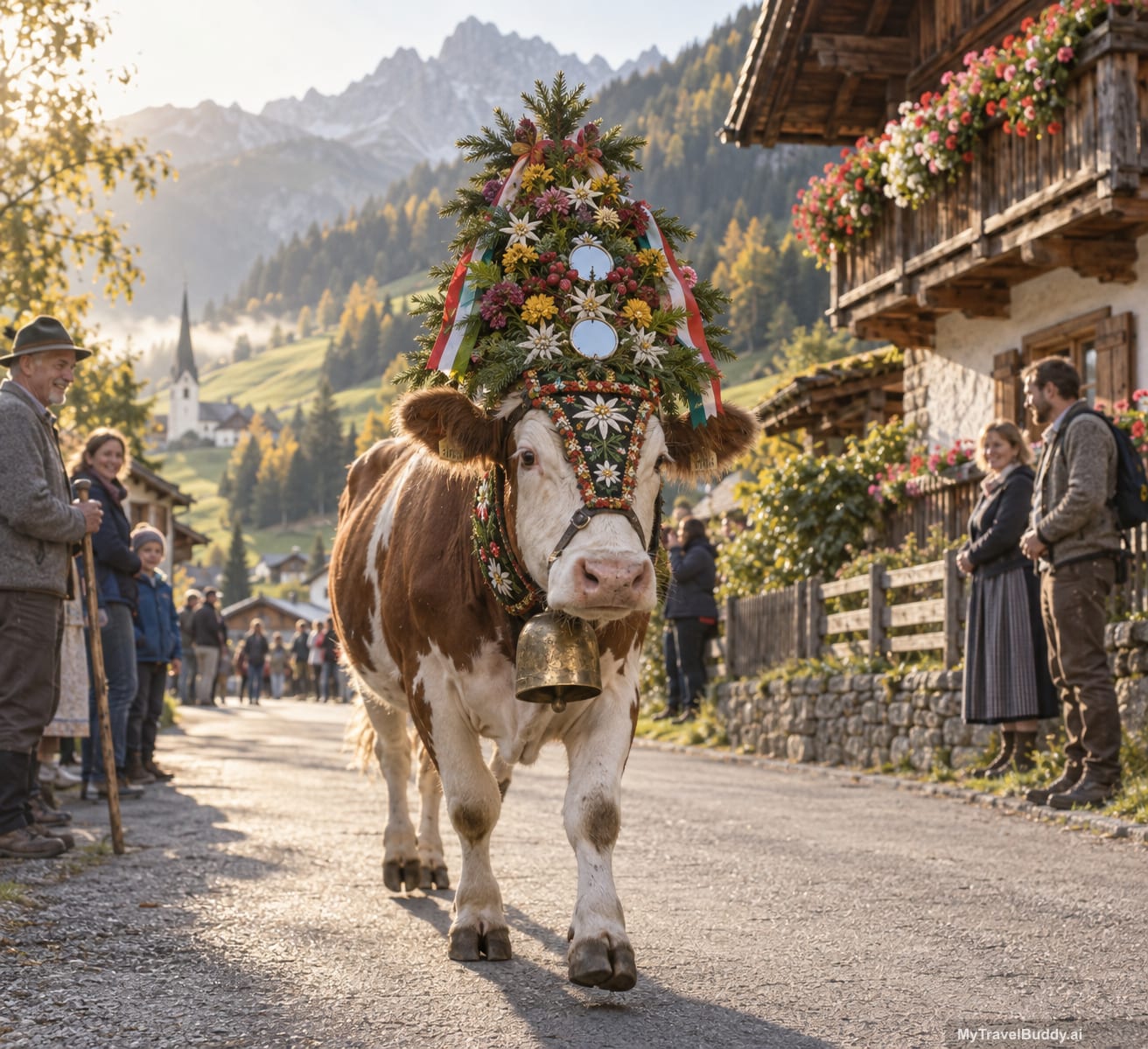
You hear it before you see it.
Not the brass band, which has been going since ten, and not the crowd, which is already three deep along the road. Something lower and more irregular: a few hundred bells, none of them in time with each other, coming down out of the trees. The sound arrives in the village about a minute before the first animal does, and for that minute everyone stops talking.
That is the Almabtrieb, the alpine cattle drive, and this is its last stretch for 2026. The wave that started in early September runs out in the first days of October.
There is one rule behind the whole thing that almost nobody explains at the roadside, and once you know it, you are watching a completely different event.
The Flowers Are a Sentence, Not a Costume
The enormous headdresses — fir branches, paper and alpine flowers, small round mirrors, ribbons, sometimes a saint or the name of the pasture worked into the frame — are not decoration put on for visitors.
They are a statement about the summer.
The wreaths go on only if the alpine season passed without loss: no animal fell, none died of illness, nothing happened to anyone working up on the Alm. Putting them on is an act of gratitude for that. If something did happen, the wreaths stay off. What that looks like varies by valley — some herds come down entirely plain, some wear mourning colors, in some places only the lead cow stays bare — but the meaning is the same everywhere, and it is legible from a long way off.
This is the part I would want someone to tell me before I went. It means an undecorated herd is not a herd that missed the festival. It is a herd telling you something. If you ever find yourself at a drive where there is no music and no flowers, the right response is to be quiet and not ask why nothing is happening today.
It is also the reason the tradition has survived being watched. A show would put the wreaths on every year. This one does not.
There Is No Single Almabtrieb
It helps to understand that the drive down is not one date but a season.
The reason is unromantic: above about 2,000 metres, a high pasture gets fewer than seventy-five grazing days a year. When the grass stops regrowing, the animals have to come down, and staying too long risks a weather break, an injured animal, and an overgrazed meadow that starts the next spring in worse shape. So the herds return, the hut is winterised, the water is shut off, the summer's cheese and butter come down with them. The drive is the last working day of a season, not a parade someone scheduled.
Some of those descents happen in mid-August, quietly, with no audience at all. The ones announced as festivals cluster on the Saturdays of September, often the 12th, 19th, and 26th, with a few running into October.
Both are real. One is work without spectators; the other is the same work with them.
Which matters for planning, because it means you should not book a trip around a date. Book a weekend, and confirm with the local tourist office close to the time. An early cold snap pulls the drive forward. A mild September pushes it back. There is no fixed day because there cannot be one.
Where the Last 2026 Drives Are
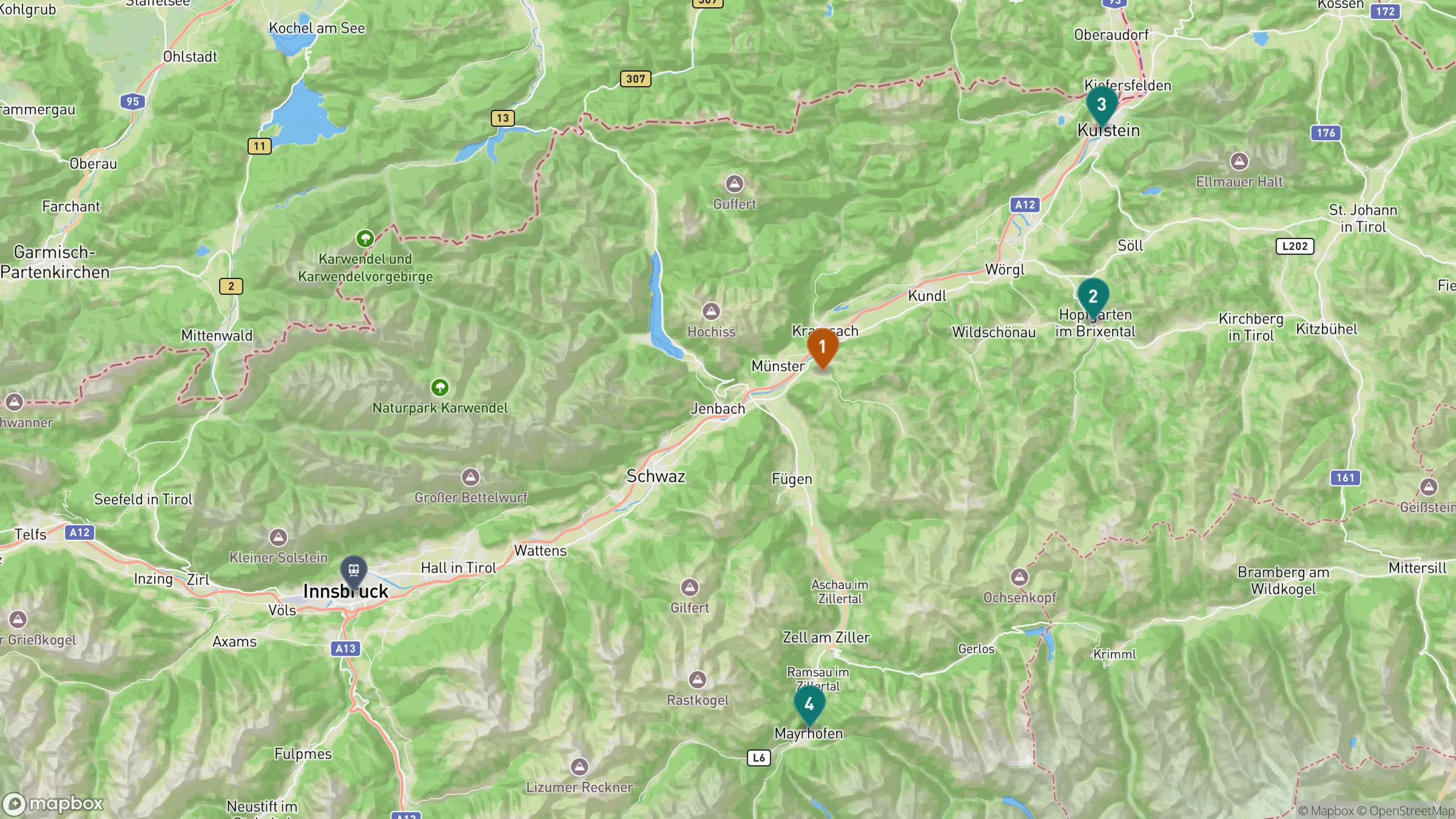
The map above covers the corner of Tyrol where the remaining drives are densest, all of it within about an hour of Innsbruck.
Reith im Alpbachtal (1) holds its second and final drive of the year on Saturday 26 September. It is one of the largest in Tyrol and runs alongside the village's Kirchtag — a farmers' and craft market that starts at 10:00 with the local band in the square, with the first cows coming through the village centre from around noon. Admission is €8, free for children up to twelve. The festival is spread over two Saturdays specifically to handle the crowds, and no animal is walked through twice; the herds on the 26th are different herds.
Hopfgarten im Brixental (2) also falls on 26 September, in the next valley east.
Kufstein (3), up toward the German border, holds drives on both 19 and 26 September.
Mayrhofen (4), deep in the Zillertal, is the late one: 25 and 26 September, then again on 2 and 3 October. If you are travelling in the first days of October and think you have missed the season, you probably have not.
Tux-Finkenberg and Fügen also run drives on 26 September. Dates are published locally and can shift; check before you commit a day to it.
Big or Small — Pick Deliberately
Reith is the version most visitors mean when they say they want to see an Almabtrieb. It earns that: alphorn players, whip crackers, basket weavers and woodcarvers and schnapps distillers working in the open, Kiachl and dumpling soup, several bands on several stages, and the genuine article walking down the middle of it.
It also draws thousands of people, and the tone by mid-afternoon is closer to a beer festival than a homecoming.
If that is what you want, go to Reith and enjoy it without apology. It is not staged, it is just popular.
If what you actually want is the sound of the bells coming out of the trees and a herd arriving among the people who spent the summer with it, then the better choice is a smaller village drive, or — best of all — staying at a farm that drives its own animals down and asking when they are coming. No barriers, no brass band, and you see it from the working side.
Neither version is more authentic. They are the same event at different volumes. Just choose on purpose rather than by default.
Where to Stand
Get there early. At the big drives the good roadside positions are taken well before the animals arrive, and the last hour before noon is when the village fills.
Stand back from the road surface itself, not just behind the barrier where one exists. A herd that has been on the mountain for four months is walking through a village, past parked cars, between strangers. The animals are alert and the people walking with them are working — this is the hardest part of their day, not the pleasant part. Give the herders room, do not step out to photograph from the centre of the lane, and keep dogs and small children in close.
Sound carries in these valleys, so pick a spot where you can see up the road rather than only across it. You want the approach, not just the passage.
If you are coming by train, the ÖBB line runs along the Inn Valley and Brixlegg is the station for the Alpbachtal. From the platform it is about 1.8 miles to the centre of Reith, roughly 45 minutes on foot, gently uphill; regional buses run the same stretch and are the sensible option on a festival morning. Driving from Innsbruck is about 28 miles and 41 minutes without traffic — but village parking on a drive day fills early and is usually routed to outlying fields, so build in a walk either way.
This is the kind of day where having something keep track of the moving parts helps more than another browser tab: the shifting start time, the fallback village if your first choice is rained out, the train back. A travel buddy that holds the plan while you watch the road is quietly useful here.
The Forecast, and the Days After
The near-term forecast for the Alpbachtal looks genuinely good for the final weekend. Saturday 26 September is currently showing mainly clear skies, a high near 72°F and a low around 45°F, with no rain expected. Thursday the 24th carries a 70 percent chance of light rain, and mornings all week are starting in the mid-40s.
Treat that as a forecast, not a promise — mountain weather revises itself — but if it holds, it is close to ideal: cold enough at 9:00 that you want a jacket while you wait, warm enough by noon that you stop noticing you are standing still.
And leave time for the days after the drive. Late September and early October are the clearest weeks of the year up high, and from around 1,700 metres the larches turn gold in about a fortnight. The gondolas are still running, the summer crowds are gone, the huts are closing one by one. The valley has just finished putting its animals away for the winter, and for a week or two afterward the mountains are unusually quiet and unusually sharp.
That is arguably the better half of the trip. The cows are the reason you came. The fortnight afterward is the reason to stay.
Continue wandering
One more story for the road
September 26, 2026 · Maya Roam
On the Albanian Riviera, the Sea Is Still Warmer Than the Air
The Ionian is holding about 25.6°C while the air tops out near 23°C, the loungers are coming off the sand, and the coast road is finally empty. Himarë to Sarandë is only 55.7 km — and still takes ninety minutes, which i…
Read nextInspired to go?