
Travel story 10 min read
MyTravelBuddy Stories
Valparaíso's Most Famous Elevator Is Closed. Seven Others Still Run.
Valparaíso built around thirty hillside funiculars from 1883 onward. Sixteen survive, seven carry passengers in 2026, and the one in every photograph — Artillería, climbing to the Paseo 21 de Mayo lookout — has been sto…
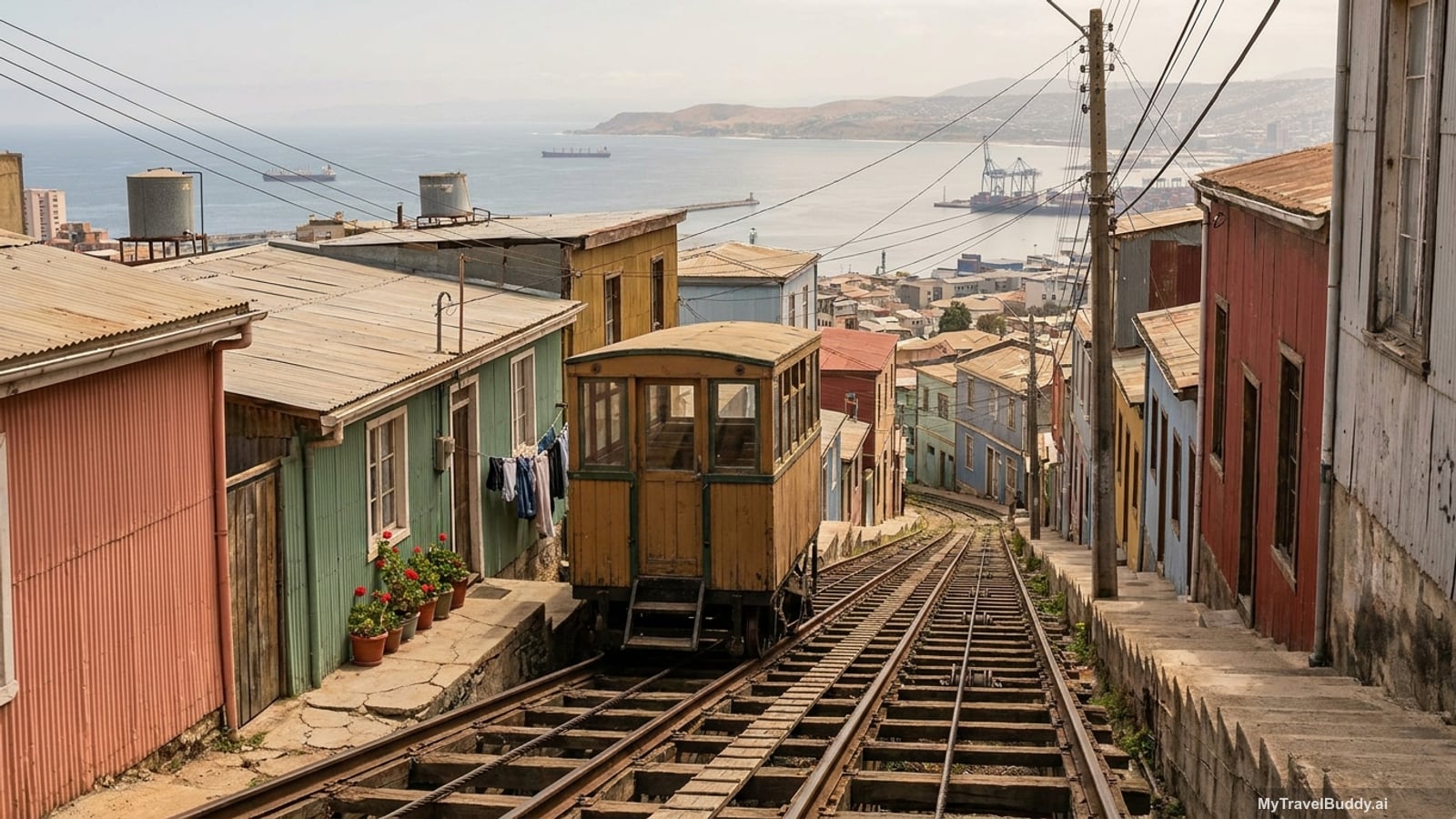
There is a moment, standing at the bottom of Cerro Artillería with the bay behind you and a wall of painted tin houses stacked overhead, when you understand what Valparaíso's elevators were actually for. Not photographs. Transport. The hills here rise so abruptly off the flat strip of port called el plan that in 1883 the city started cutting inclined railways straight into them, because the alternative was a quarter of an hour of stairs every time someone needed to get to work.
About thirty of them went up over the following decades. Sixteen are still standing. In 2026, seven carry passengers.
And the one you have seen in every photograph — Artillería, the one that climbs to the Paseo 21 de Mayo lookout over the container port — is not among them. It stopped in April 2021 and has not moved since.
That gap between the Valparaíso in the guidebooks and the Valparaíso you can actually ride is the single most useful thing to know before you arrive. So let's map it properly.
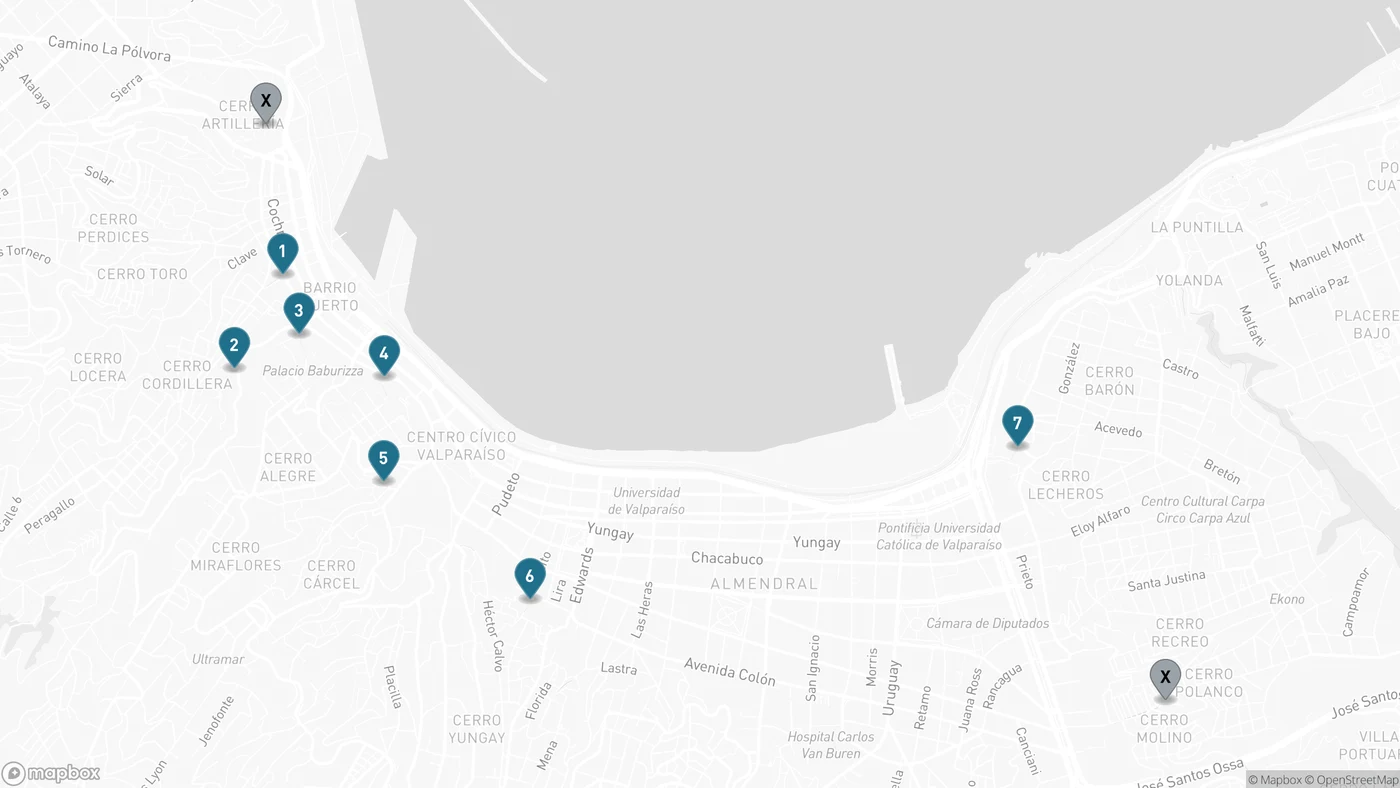
The seven ascensores running in 2026 — 1 Cordillera, 2 San Agustín, 3 El Peral, 4 Concepción, 5 Reina Victoria, 6 Espíritu Santo, 7 Barón — with grey crosses on the two best-known machines that are out of service: Artillería, top left, and Polanco, bottom right.
The seven that run
As of a 2026 verification of the public network, these are the ascensores carrying passengers: Concepción (1883, Calle Prat up to Paseo Gervasoni), Cordillera (1887, Calle Serrano up to Plaza Eleuterio Ramírez), El Peral (1901, Plaza de Justicia up to Paseo Yugoslavo), Reina Victoria (1903, Calle Elías up to Paseo Dimalow), Barón (1909, Avenida España up to Avenida Diego Portales), Espíritu Santo (1911, Calle Aldunate up to Cerro Bellavista) and San Agustín (1914, on Cerro Cordillera).
All sixteen survivors are National Historic Monuments — Polanco since 1974, fourteen more in September 1998, and the Van Buren hospital elevator in 2010. That status protects them. It does not make them run.
Practical numbers, because they are small and pleasant: since 2 January 2026 a ride costs CLP $200, except Concepción at $300. A bicycle costs $600 and is only accepted on Barón and Cordillera. There is a $1,000 foreign-visitor fare. Children under fourteen, students with a valid credential, and anyone over sixty ride free. You pay cash in the booth at the bottom. Even at the visitor rate, this is somewhere around a dollar to be hauled up a cliff in a wooden box from 1903, which remains one of the better transactions available anywhere.
The published winter timetable runs 07:00 to 21:30 on weekdays and 08:00 to 21:30 at weekends and holidays — but that is the winter schedule, and October here is spring. Treat it as a guide and read the card taped in the booth window. The useful part is the evening end: sunset this week falls around 19:51, so if the posted closing time holds, the elevators are still running for a good hour and a half after the hills turn gold.
The five you can do on foot, and the walk that replaces Artillería
Five of the seven sit inside a box you could cross in fifteen minutes. This is the part of the city where the ascensores stop being a novelty and start being genuinely useful — you take them in the direction that matters, which is up, and you walk down.
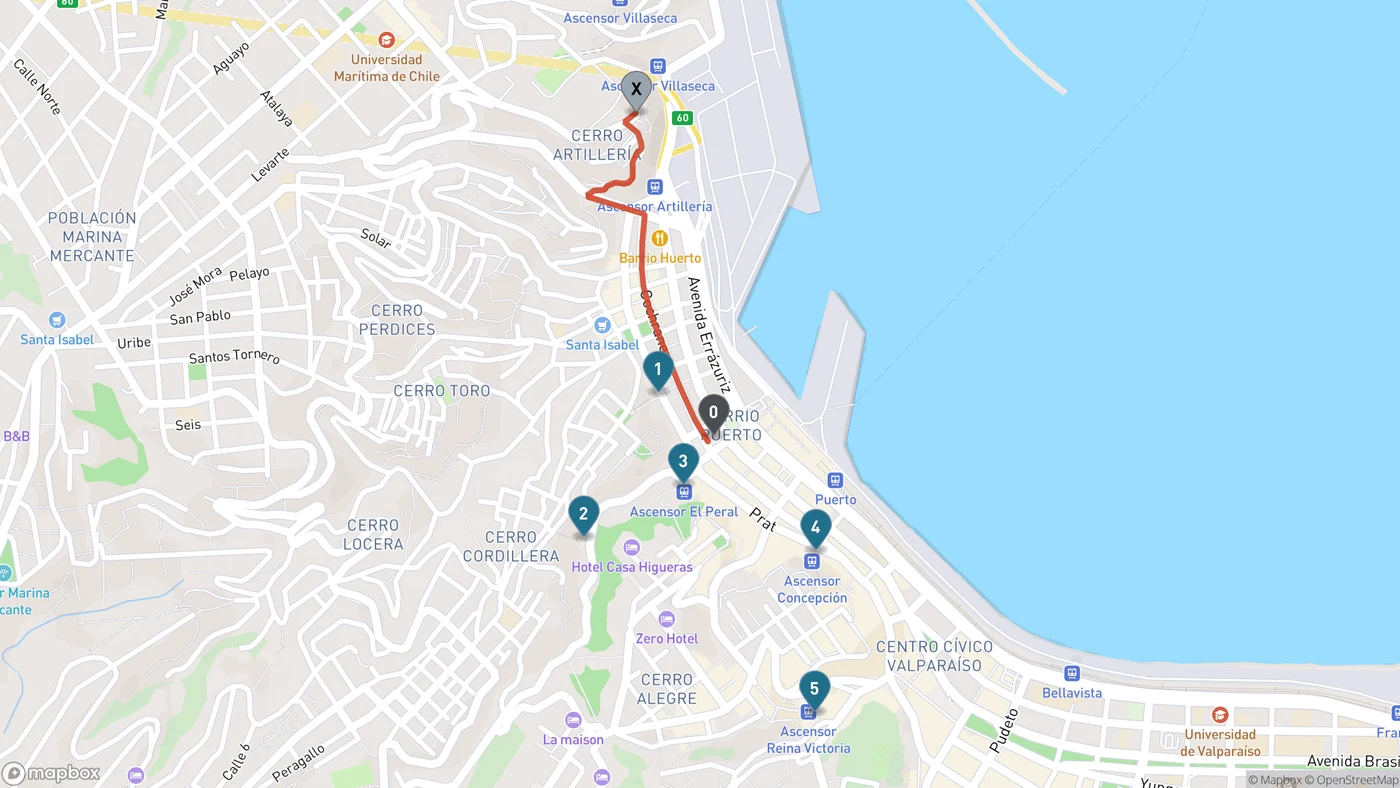
0 Plaza Sotomayor, then 1 Cordillera, 2 San Agustín, 3 El Peral, 4 Concepción and 5 Reina Victoria. The red line is the 938-metre walk up to the Paseo 21 de Mayo lookout, where the closed Artillería's upper station sits. Note that the base map still labels the Artillería station as though you could use it — almost everything does.
From Plaza Sotomayor it is 136 metres, about two minutes, to the foot of El Peral. Ride up to the Paseo Yugoslavo, then walk the 313 metres, six minutes, along the clifftop to Paseo Gervasoni on Cerro Concepción, which is the view everybody means when they say Valparaíso: a facing wall of mismatched corrugated-iron houses dropping toward the water. Drop back down on Concepción — the oldest funicular in Chile, and worth the extra hundred pesos for that alone — and it is 543 metres, eight minutes, along Prat and up to the foot of Reina Victoria, which lifts you to the Paseo Dimalow on the western face of Cerro Alegre. From Dimalow back to Yugoslavo is 484 metres, eight minutes, which closes the loop without repeating a single slope.
Now the part the published guides get wrong. The Paseo 21 de Mayo lookout is still there, still free, and still the widest view of the harbour in the city. You simply cannot ride to it. The walk is 938 metres and about sixteen minutes from Plaza Sotomayor, or 1,036 metres and eighteen minutes from the Muelle Prat, and it is uphill the whole way. That is a real cost, not a rounding error — but sixteen minutes is a walk, not an expedition, and the Museo Naval y Marítimo is waiting at the top of it. Go in the morning while your legs are fresh, rather than tacking it onto the end of the day the way the four-hour tour itineraries still do.
A travel buddy that knows which machines are running this week is the difference between that being a pleasant climb you chose and a nasty surprise you didn't.
Where I would actually spend the afternoon
Here is my honest preference, and it is not the postcard. Cerro Alegre and Cerro Concepción are lovely and completely aware of it — cafés, boutique hotels, a steady current of people photographing the same staircase. Go, absolutely. But Cordillera and San Agustín are the two I would not skip.
They climb out of Barrio Puerto, the old working port quarter, onto Cerro Cordillera: steep, lived-in, laundry over the passages, almost no visitors. Cordillera is only 179 metres, three minutes, from Plaza Sotomayor, and from its upper station at Plaza Eleuterio Ramírez it is 582 metres, nine minutes, across the hill to the top of San Agustín. That is a twenty-minute detour that will give you more of the actual city than another circuit of the paseos.
Two caveats, both worth taking seriously. These two are the likeliest of the seven to be shut for maintenance on any given morning — some guides still describe them as running only intermittently — so treat them as a bonus rather than the backbone of your plan. And Barrio Puerto is a working neighbourhood with a reputation for opportunistic theft: keep your phone in your pocket rather than your hand, go in daylight, and don't wander the emptier stair passages alone after dark. That is ordinary port-city sense, not a reason to stay away.
The other two run further out. Espíritu Santo lands you on Cerro Bellavista, 497 metres and eleven minutes from the Museo a Cielo Abierto's open-air murals and 895 metres, twenty minutes uphill from Neruda's La Sebastiana. Barón is the outlier — about 2.3 kilometres and five minutes east by metro from Estación Puerto, then a 328-metre walk — and it is the one locals use, carrying bicycles up to Cerro Barón and a view back along the whole bay.
Don't trust the pin
Three sources will mislead you, so check them against each other.
Google currently marks Ascensor Reina Victoria as permanently closed. It isn't. It took a short closure in August 2026 for repairs to its pedestrian walkway, and the municipality has been running a CLP $157 million conservation project on the Paseo Dimalow above it with the businesses open throughout. A temporary closure got frozen into a permanent-looking label, and nearly eight thousand reviews keep it near the top of the results.
Tour-operator pages are worse, because they are confident. More than one 2026 "updated guide" still lists Artillería and Polanco under currently operating, and sells a four-hour route that ends with a ride up to the Paseo 21 de Mayo. Artillería has been stopped for five and a half years.
And the Ascensor Van Buren genuinely works, which is why it keeps appearing on lists — but it belongs to the hospital and is not open to the public.
The single reliable method is the oldest one: look at the booth. If the cabin is lit and someone is sitting in the kiosk taking coins, it is running today.
What is happening to Artillería, and why Polanco matters more than you'd think
Artillería's restoration is real, and slower than it sounds. The Ministry of Public Works' architecture division published a tender in December 2025 — Stage 1: upper and lower stations — with an official budget of CLP $6,132 million, offers closing in April 2026 and the award scheduled for the end of August. An earlier, broader tender in 2023 never became actual work.
Read that carefully: Stage 1 restores the two station buildings. It does not, by itself, put cars back on the rails. There is no official reopening date, and anyone who gives you one is guessing.
Polanco is the loss that gets less attention and deserves more. It is not a funicular at all — it is a true vertical elevator, a shaft cut into the rock of the hill with a tunnel running in at the bottom, the only one of its kind here and a monument since 1974. It is also, because of that flat step-on platform, by far the most accessible machine in the network. It is out of service, in restoration and design through 2026. Which means that right now every working ascensor in Valparaíso is an inclined car with a stepped floor and a lip to cross — manageable with a bit of help, difficult in a wheelchair. If step-free matters to you, plan around the paseos you can reach on the flat and the taxi routes up the back of the hills, and don't count on the elevators.
Timing your week
Spring here is not settled. The forecast for the coming week has a genuinely wet middle: Tuesday the 6th is modelled at 99 mm of rain with a 100 percent probability, a high of only 13.5 °C and gusts to 26 km/h, and Wednesday is still unsettled at around 17 mm. Forecasts move, but that is a storm, not a shower, and Valparaíso's hills are tiled, painted concrete staircases that turn genuinely slippery — and open-air funiculars are exactly the sort of thing that suspends service in high wind.
Then it clears. Thursday the 8th and Friday the 9th both come in dry, mild at 17 °C, with the lightest winds and the clearest skies of the period. If you have any flexibility in a Valparaíso week, that is where the elevator day goes. Spend the wet middle on the museums and the long lunches, which this city does extremely well, and save the hills for after the front passes.
Sixteen machines survive out of about thirty. Seven are working. One of them is the oldest funicular in the country and still climbs a hundred and forty-three years after it opened, for two hundred pesos, carrying people home from work.
Check the booth, ride up, walk down, and spend the sixteen minutes to the lookout on your own legs. The view from the Paseo 21 de Mayo has not gone anywhere.
Continue wandering
One more story for the road
October 3, 2026 · Maya Roam
Pick One Waterhole and Wait: Etosha Before the Rain
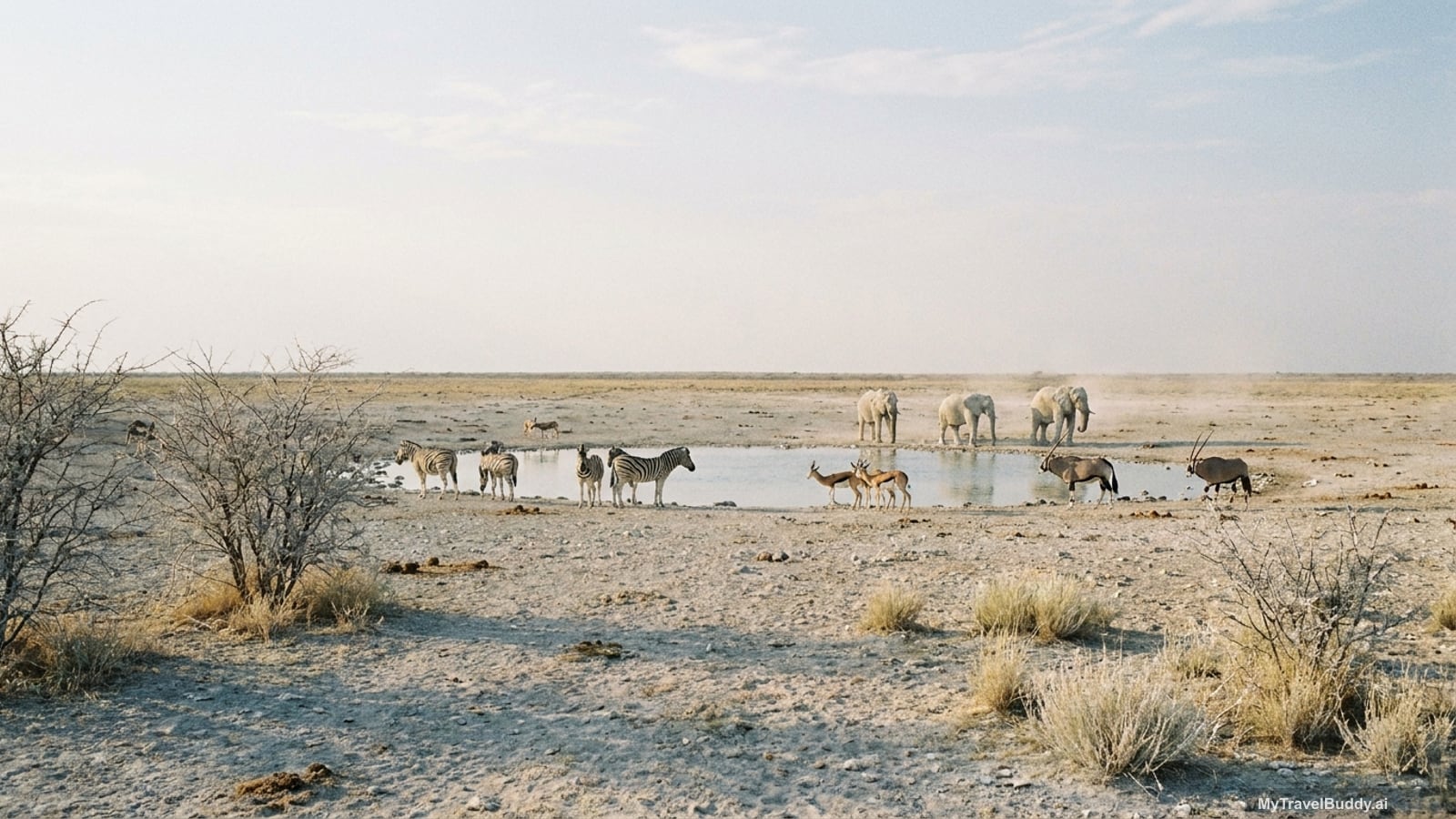
By early October, Etosha has gone about six months without meaningful rain, the pan is a dry saltflat, and every thirsty animal in the park is funnelled into a handful of known waterholes. Then the forecast turns: rain…
Read nextInspired to go?