
Travel story 5 min read
MyTravelBuddy Stories
Start in San Ángel, End in Coyoacán
San Ángel and Coyoacán are two miles apart and almost everyone pairs them in the wrong order. A Saturday plan built around the bazaar, the afternoon rain, and the one ticket you have to buy days early.
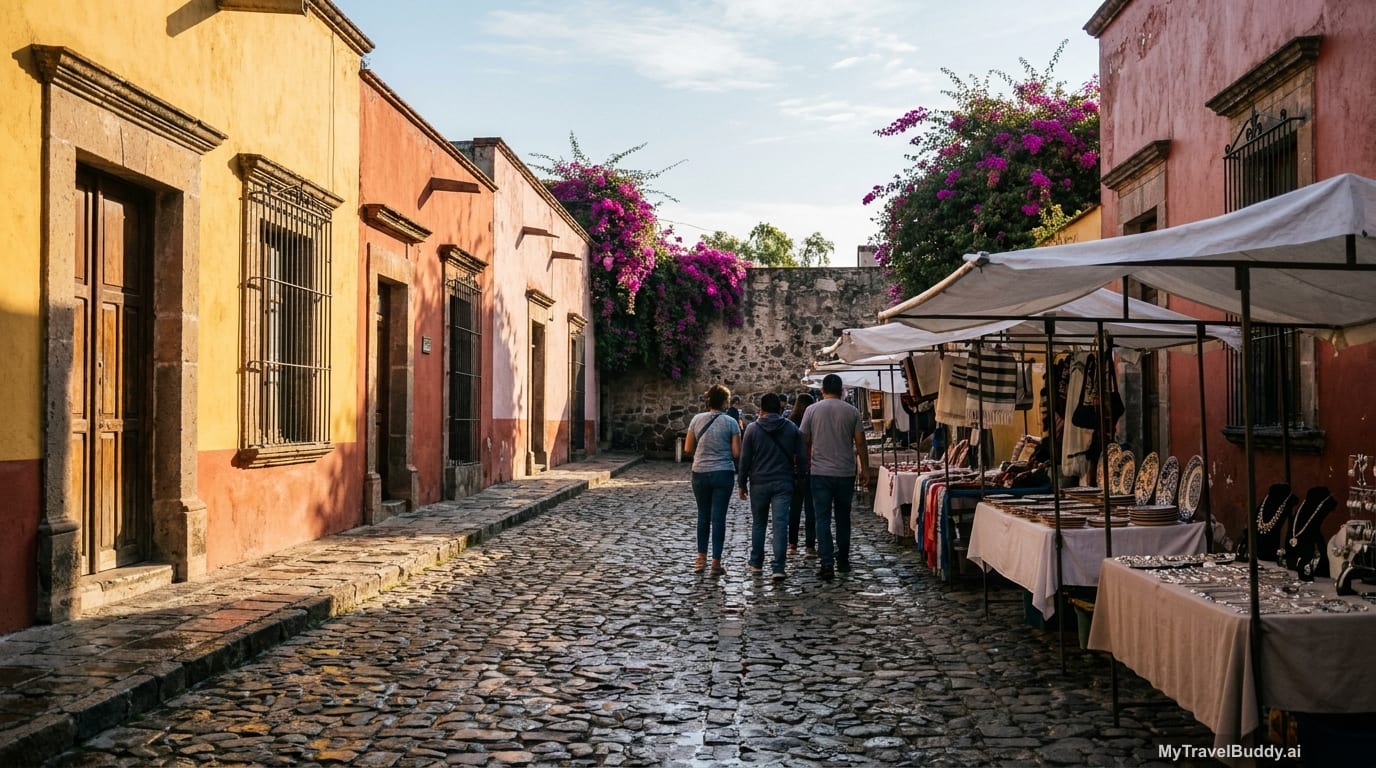
Almost everyone does this day in the wrong order.
San Ángel and Coyoacán sit about two miles apart in the south of Mexico City, two colonial villages that the city grew around and never quite digested. Guidebooks pair them, which is right. Then they tell you to start in Coyoacán, which is wrong — at least on a Saturday, and at least this time of year. Coyoacán is open every day and has a roof over most of its best moments. San Ángel's Saturday only happens on Saturday, and it happens outdoors.
So: west first, east after. Here is what that actually looks like.
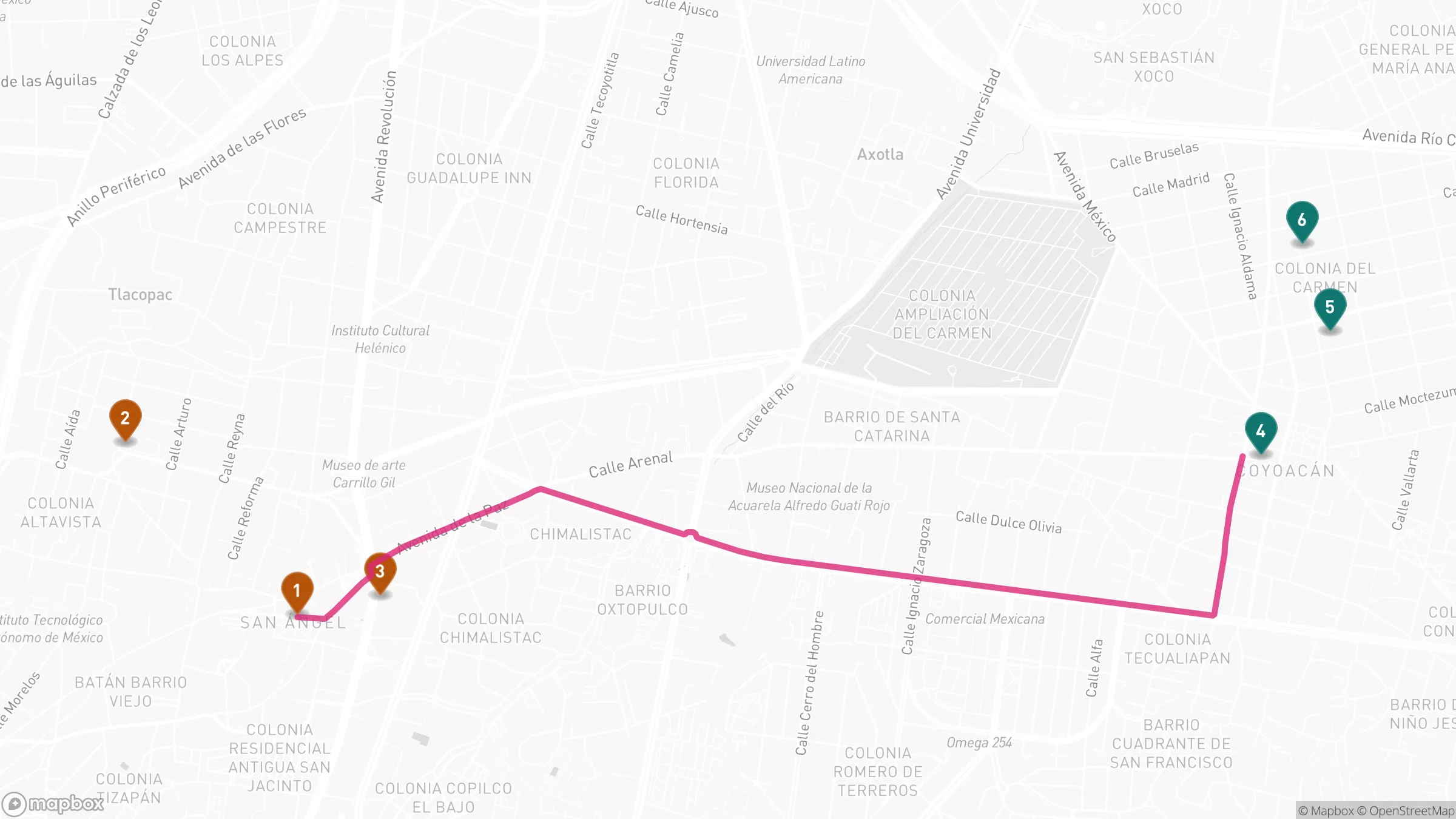 Stops 1–3 in San Ángel, 4–6 in Coyoacán, and the short hop between them.
Morning: Plaza San Jacinto, before it fills
Get to Plaza San Jacinto by nine-thirty. The stalls are still going up, the cobblestones are usually still damp from the night before, and you can actually see the plaza — the low ochre and rose facades, the old stone walls, the bougainvillea doing what bougainvillea does.
El Bazar Sábado opens at ten and runs into the early evening. It has been on this square since the mid-1960s, and it is not the souvenir trade. The makers are largely juried and many sell to you directly: Talavera and other ceramics, Oaxacan textiles, silver, lacquerware, glass. Prices reflect that. The indoor rooms of the old house are where the more serious work lives; the open-air painting stalls spread across the plaza and the adjoining square are a different, looser thing — worth a slow lap, and a better place to find something small you'll actually use.
By about eleven-thirty the plaza is shoulder-to-shoulder. That is your cue to walk, not to leave.
Museo de El Carmen is six minutes downhill on Avenida Revolución — a former Carmelite college with a tiled triple dome, colonial painting upstairs, and the crypt everyone talks about: a group of naturally mummified bodies found under the church. It is quieter than its reputation suggests.
If you'd rather have architecture than relics, walk fifteen minutes the other way to the Museo Casa Estudio Diego Rivera y Frida Kahlo — Juan O'Gorman's 1930s functionalist twin houses, one blue, one rose-red, linked by a rooftop bridge, ringed by a fence of organ-pipe cactus. Two people who could not live together, in two houses that could not quite be one. It is a small museum and a very good twenty minutes.
Pick one. Doing both eats the part of the day you need later.
The hop east
The two plazas are only about 2.2 miles apart by road, mostly along Avenida de la Paz and then Avenida Miguel Ángel de Quevedo. Routing puts a car or rideshare at roughly fourteen minutes without traffic, and Saturday traffic here is real but not brutal. Public transit routes the same trip in about twenty-nine minutes door to door.
You can walk it — about two miles, roughly forty-five to fifty minutes — and I'd tell you not to. It is a flat, loud, unlovely road walk with nothing on it, and at 7,350 feet you'll feel the afternoon differently than you expect. Save the legs.
Afternoon: Coyoacán, with a roof nearby
Jardín Centenario and the adjoining Plaza Hidalgo are the center of gravity: the coyote fountain, laurel trees, a permanent low hum of buskers and balloon sellers and people eating ice cream at three in the afternoon. It is touristy and it is also genuinely where people from the neighborhood are, which is a rarer combination than it sounds.
Mercado de Coyoacán is a seven-minute walk north. Go for the tostada counters — stacked crab, ceviche, pata, pulpo — and go hungry. It is bright, loud, cheap by central-city standards, and the best food decision of the day.
Museo Frida Kahlo, the Casa Azul, is three blocks further on Calle Londres. One thing matters more than everything else about it: buy a timed ticket online, days ahead, before you plan the rest of this. It is one of the most-visited museums in the country, weekend slots go first, and the queue for same-day entry is a way to lose an afternoon. If you can only get a weekday slot, move your whole Casa Azul visit to another day and let Saturday belong to San Ángel and the market — the day still works.
What the weather is actually doing
Late September is the tail of the rainy season, and this week the pattern is textbook: dry, bright mornings and a build through the afternoon. For the coming Saturday the models put rain chances in the single digits at nine in the morning, near fifty percent by three, and around two-thirds by six in the evening. Daytime highs sit in the mid-twenties Celsius (mid-to-high seventies Fahrenheit) and nights drop to around 13°C — colder than most people pack for.
Which is the other argument for going west first: the outdoor half of the day happens while the sky is still holding, and by the time it isn't, you're in a market hall or a museum or under an arcade with a coffee. Bring a light rain layer and a warm one. Neither is optional.
What to skip
Skip trying to fit both San Ángel museums and the Casa Azul into one Saturday — that's three ticket lines and no lunch. Skip the Avenida Insurgentes craft market on the way; the Bazar makes it redundant. And skip the idea of doing this on a Sunday. The bazaar won't be there, and you'll have driven across the city for half a day.
Two villages, one direction, one Saturday. Start where the clock is running.
Continue wandering
One more story for the road
September 26, 2026 · Maya Roam
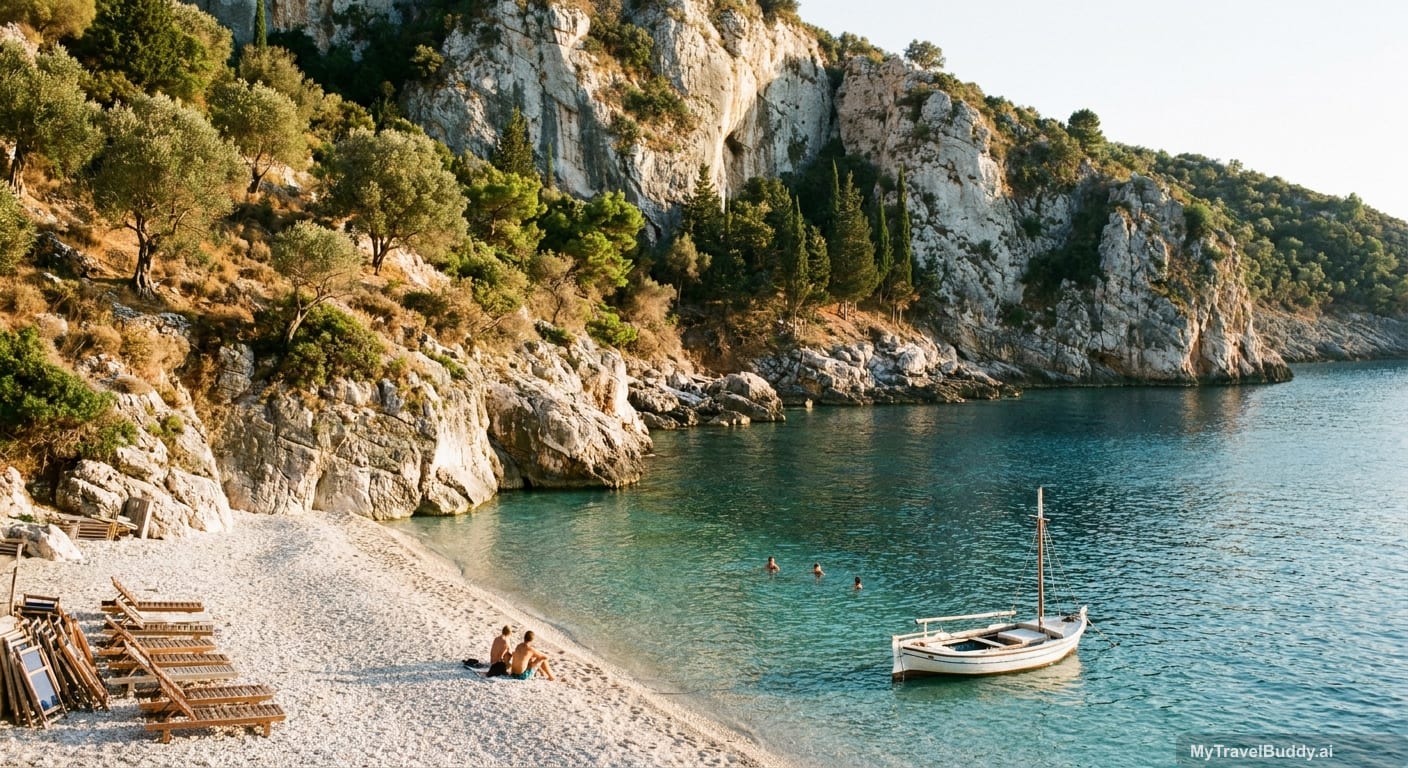
On the Albanian Riviera, the Sea Is Still Warmer Than the Air
The Ionian is holding about 25.6°C while the air tops out near 23°C, the loungers are coming off the sand, and the coast road is finally empty. Himarë to Sarandë is only 55.7 km — and still takes ninety minutes, which i…
Read nextInspired to go?