
Travel story 10 min read
MyTravelBuddy Stories
Ponta da Ferraria Is Only Warm for Two Hours a Day
On the western tip of São Miguel, hot spring water rises through the seabed into a basin of black lava open to the Atlantic. It is only warm within about two hours of low tide — and that window slides roughly fifty minu…
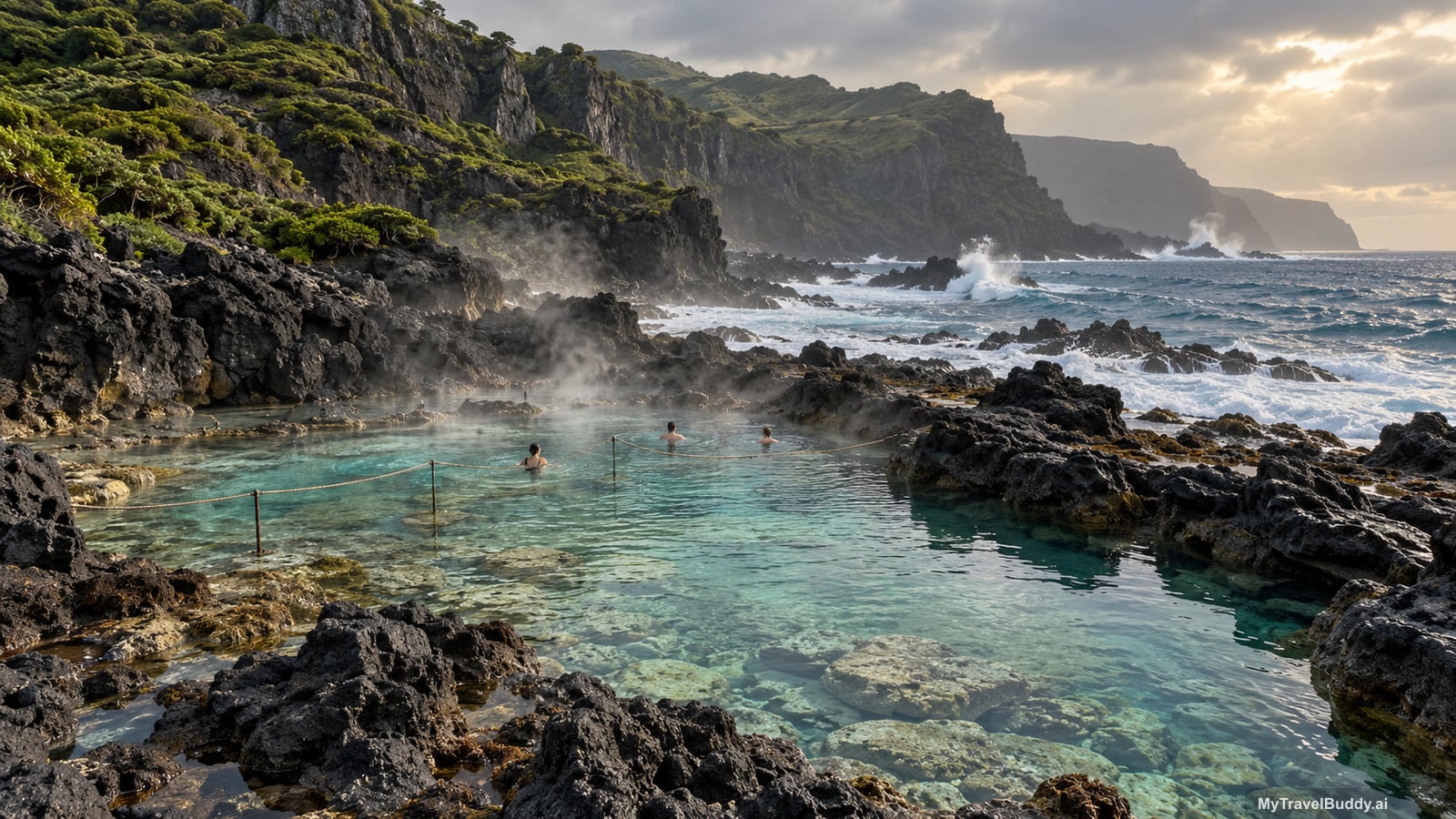
The thing nobody tells you about Ponta da Ferraria is that it has a schedule, and the schedule is not yours.
On the western tip of São Miguel, near Ginetes, hot spring water pushes up through the seabed into a basin of black lava rock that is open to the Atlantic. When the tide pulls back, the spring wins, and you can lower yourself into genuinely warm water with the open ocean a few metres away. When the tide comes in, the Atlantic wins, and the same pool is cold, choppy and not worth the drive.
The spring flows at more or less the same rate all day. The ocean does not. That is the entire mechanism, and everything practical follows from it.
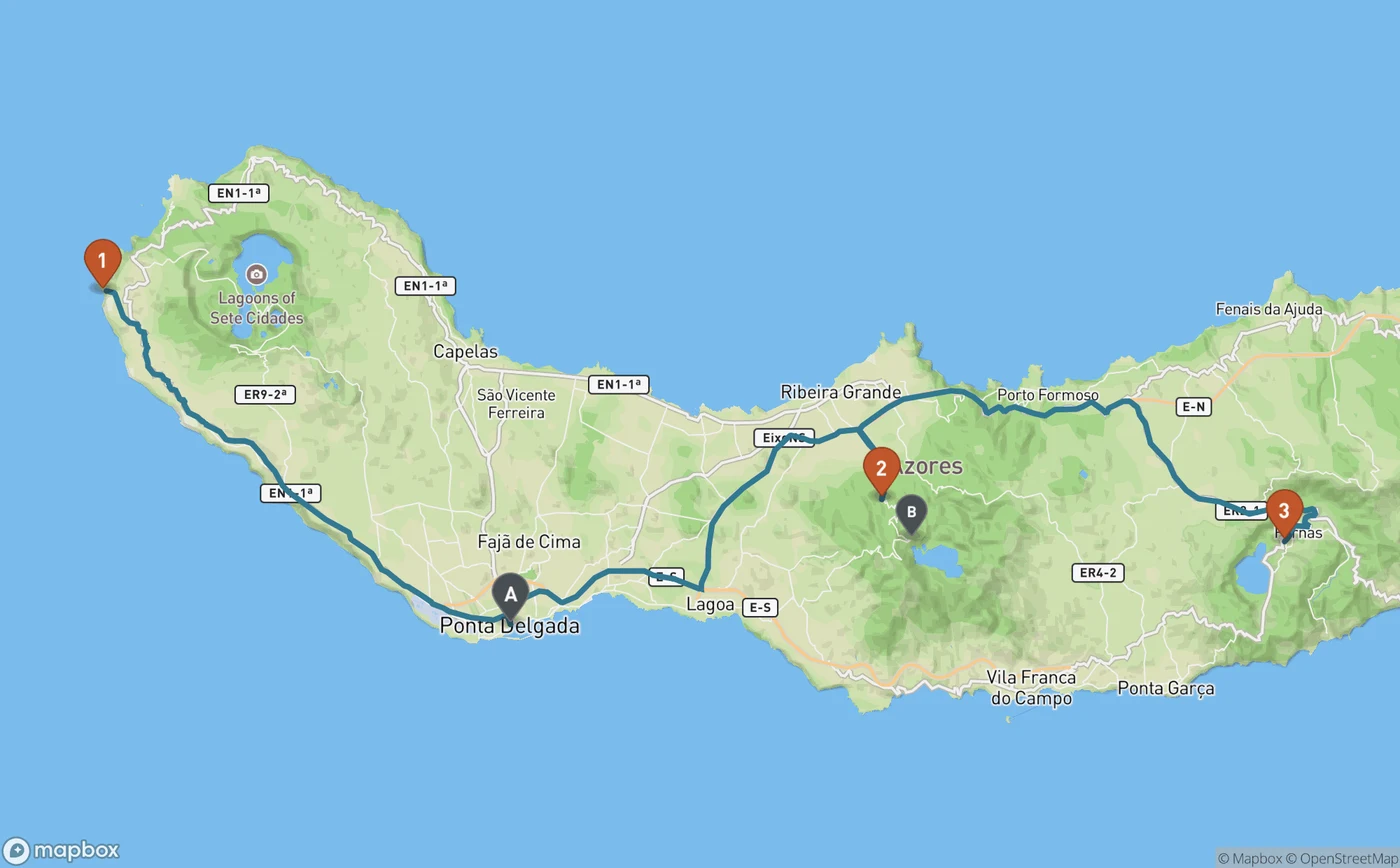
The thermal spine of São Miguel: 1 Ponta da Ferraria on the west tip, 2 Caldeira Velha in the centre, 3 the Furnas pools in the east. A is Ponta Delgada, B the Lagoa do Fogo viewpoint. Ferraria is 25 km and about 39 minutes from the Portas da Cidade; Furnas is 44 km and about 49 minutes the other way.
The two-hour rule, and the part that catches people out
Local operators and resident-written guides converge on the same window: be in the water within about two hours either side of low tide. Four hours on paper, and the quality falls off noticeably at the edges.
Here is what the guides leave out. Low tide moves roughly fifty minutes later every day. So the window you read about on Monday is not the window you get on Saturday — and in October, with the light going before 19:20, the good low tide walks straight off the end of the day.
Modelled tide and swell for Ferraria this week, in Azores local time:
| Day | First low | Second low | Sunrise | Sunset | Swell |
|---|---|---|---|---|---|
| Mon 5 Oct | 03:00 | 16:00 | 07:41 | 19:19 | 0.8–1.3 m |
| Tue 6 Oct | 04:00 | 17:00 | 07:42 | 19:18 | 0.7–0.8 m |
| Wed 7 Oct | 05:00 | 18:00 | 07:43 | 19:16 | 0.7–1.1 m |
| Thu 8 Oct | 06:00 | 19:00 | 07:44 | 19:15 | 1.1–1.2 m |
| Fri 9 Oct | 07:00 | 19:00 | 07:45 | 19:13 | 0.8–1.1 m |
| Sat 10 Oct | 07:00 | 20:00 | 07:46 | 19:12 | 0.8 m |
| Sun 11 Oct | 08:00 | 20:00 | 07:47 | 19:11 | 0.8–1.1 m |
Read down the second-low column and you can watch the week close itself. Monday through Wednesday, the afternoon low sits in full daylight and you get the whole four hours. Thursday and Friday it lands almost exactly at sunset, so you lose the back half. By Saturday it is at 20:00 — fully dark — and the only usable low has become the early one, which by then has risen into daylight at around 07:00.
Those numbers come from a marine model at hourly resolution, so treat them as roughly half an hour either way, and confirm against a proper tide table before you drive. The free Spot Azores app carries Ferraria tide times and a live webcam of the site, which is the single most useful thing you can have on your phone that week.
If you only get one shot this week, take Tuesday afternoon. Low tide at 17:00 puts the full window between 15:00 and 19:00 in daylight, and Tuesday also happens to be the flattest sea of the seven days at 0.7–0.8 metres. Saturday morning is the understudy: low at 07:00, sunrise at 07:46, calm water, and almost nobody there.
Swell decides, not just tide
Tide sets the temperature. Swell sets whether you should get in at all.
There are fixed ropes strung across the pool, and they are not decorative — you hold on to stay off the rocks. There is no lifeguard. The basalt is sharp enough that water shoes stop being optional.
This week is manageable throughout, roughly 0.7 to 1.3 metres. Thursday is the one I would be most cautious about: it never drops below 1.06 metres all day, which is the kind of sea that makes the pool more washing machine than bath. If you arrive to find waves breaking over the lip of the basin, the answer is to look at it, take the photograph and leave. The pool will still be there on a calmer tide, and people have been hurt insisting otherwise.
Plan on about 45 minutes to an hour in the water. The basin is small, the warm spots are specific — close to a vent it can be too hot to sit still, a metre away it is perfect, at the edges the ocean is mixing in and it's cold. You shuffle around until you find your temperature. Then you dry off and let the next group in.
What changed at the top of the cliff
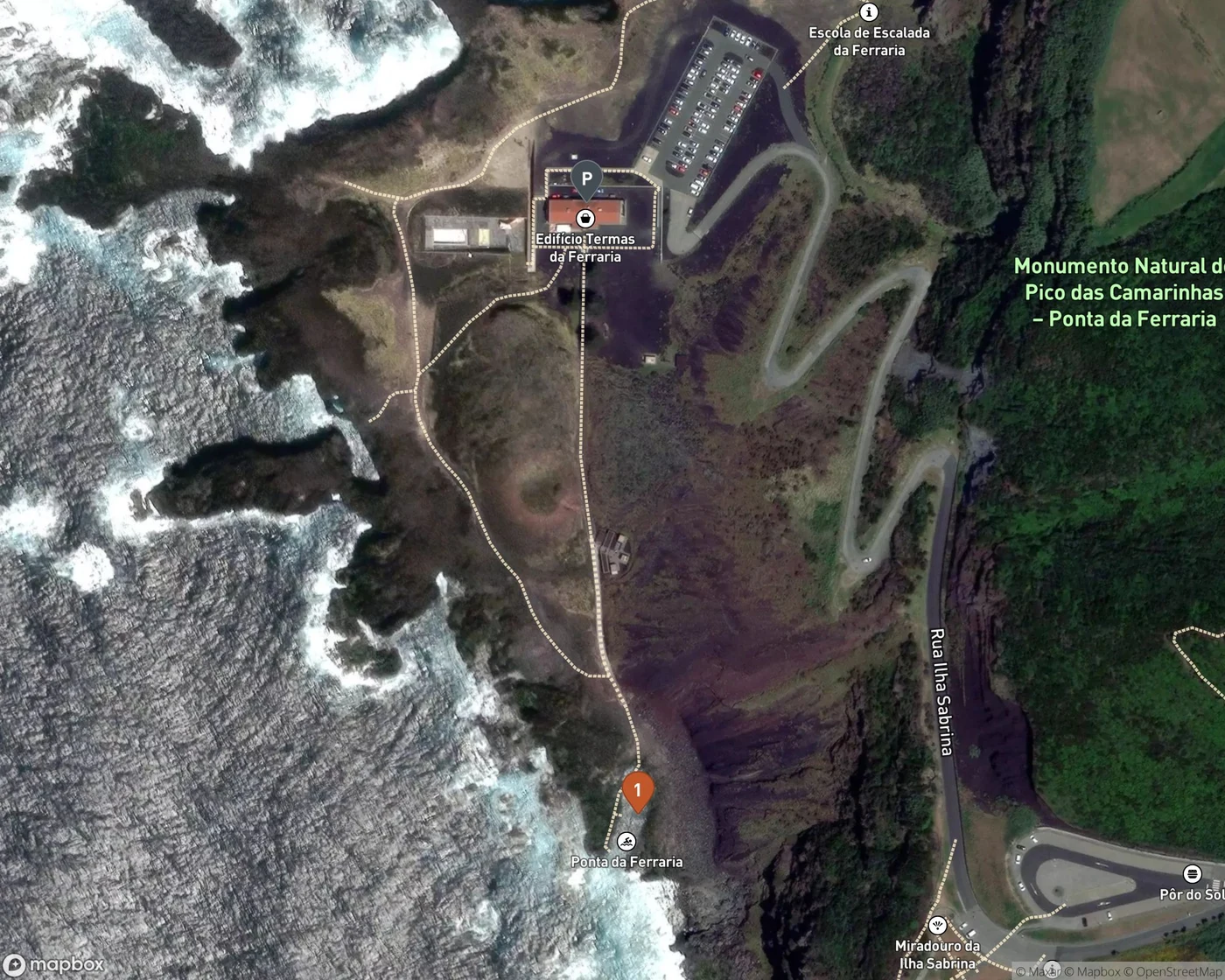
P is the clifftop car park and the Termas building; 1 is the sea pool. The track between them is the walk — down is easy, up is the part people underestimate.
You drive to the car park at the top, then walk down a paved road closed to ordinary traffic that switchbacks to the point. Five to ten minutes going down. Longer coming back up, and you will be doing it wet.
Now the bit the guidebooks have not caught up with. The Termas da Ferraria — the clifftop spa with indoor thermal pools that sits right above the natural pool, and that half the articles still list as part of the visit — has closed for good. Açoriano Oriental and RTP's Azores service reported the definitive closure after sixteen years of operation, with staff dismissed and the operating contract cancelled, following prolonged access problems made worse by rockfalls and a dispute between the operator and the Regional Government. The site had already been quiet for months. Google lists it as permanently closed, and for once Google is right.
What that means for you is simple and worth knowing before you're standing there in a wet swimsuit: do not count on a spa, a café, a hot shower or a reliable changing room at the top. Bring a towel you can change under, a dry bag, and water. The free natural pool below is a separate thing entirely, still open, still unticketed, and still one of the strangest free experiences in the Atlantic.
If the sea refuses you, the rest of the west end is a perfectly good consolation. Mosteiros is 8 km and 14 minutes north, with black sand and sea stacks offshore. The Vista do Rei lookout over the Sete Cidades crater lakes is 17 km and 26 minutes inland.
The backup plan, which is most of the plan
Build the day so that Ferraria is the part that can fail. There are three other thermal options on the island, none of them tide-dependent, and all of them better in rain.
Caldeira Velha, in the forest below Lagoa do Fogo, is the nearest fallback geographically and the easiest to bolt onto a Ferraria day: 25 minutes from Ponta Delgada, and only 8 minutes from the Lagoa do Fogo viewpoint, which is the best thing to do on the island between tides. Small warm pools, a waterfall, tree ferns, admission charged at the gate. It is 51 minutes from Ferraria itself, so it works better as a separate half-day than a same-afternoon pivot.
Furnas is the real answer for the back end of this week, and here is why. Poça da Dona Beija is open 08:30 to 23:00, with last entry at 21:30 — which means that on Thursday through Sunday, when Ferraria's low tide falls at or after sunset, you can still be in hot water at nine at night. Two things to know in advance: tickets are sold exclusively online, so buy before you drive the 49 minutes from Ponta Delgada, and each ticket caps your stay at an hour and a half. That is a sensible amount of time in 38-degree iron water, but it is not an evening-long soak, and it catches people out.
Parque Terra Nostra is an eight-minute walk from Dona Beija and a completely different proposition — a botanical garden built around a very large, very orange thermal pool. The iron in the water will stain a pale swimsuit permanently. Wear the dark one. From Terra Nostra it is 18 minutes on foot to the Caldeiras das Furnas, where the ground steams in the middle of the village and the cozido is cooked in volcanic holes in the earth.
Caldeira Velha to Furnas is 36 minutes, so centre-then-east is a clean day. Ferraria to Furnas is 75 minutes across the whole island, which is why you do not try to do both in one afternoon.
The weather, and where it points
This is a good week here. Ponta Delgada sits at 20 to 23 °C every day through Sunday, nights no colder than 15, and the rain is incidental — under 2 mm on the wettest of the next seven days. Furnas runs a degree or two cooler and damper, as it always does, with its real rain arriving on Tuesday the 13th.
Wind is the variable worth watching. Saturday the 10th is the calmest day of the week at Ponta Delgada, gusting only to 14 km/h, which is part of why that morning low tide is such a good bet. Friday and Sunday gust to around 33 km/h, and the following Monday hits 49, which will put chop on the pool regardless of what the tide is doing.
One honest caveat
There is no step-free way to the Ferraria pool. It is a steep paved descent followed by a scramble over basalt and into moving water, with no lifeguard and no handrail except the ropes in the pool itself. If that doesn't work for you, Terra Nostra and Poça da Dona Beija have proper paths, steps and handrails into the water, and Terra Nostra in particular is a lovely half-day regardless of whether you swim.
Check the tide first, then the swell, then the forecast — in that order. Buy the Furnas ticket in advance so the evening has somewhere to go. And if you drive out to the west tip and find the Atlantic sitting on top of the pool, let it. Drive ten minutes north to Mosteiros, watch the sea do what it is doing, and come back at the next low. It will be fifty minutes later than this one.
Continue wandering
One more story for the road
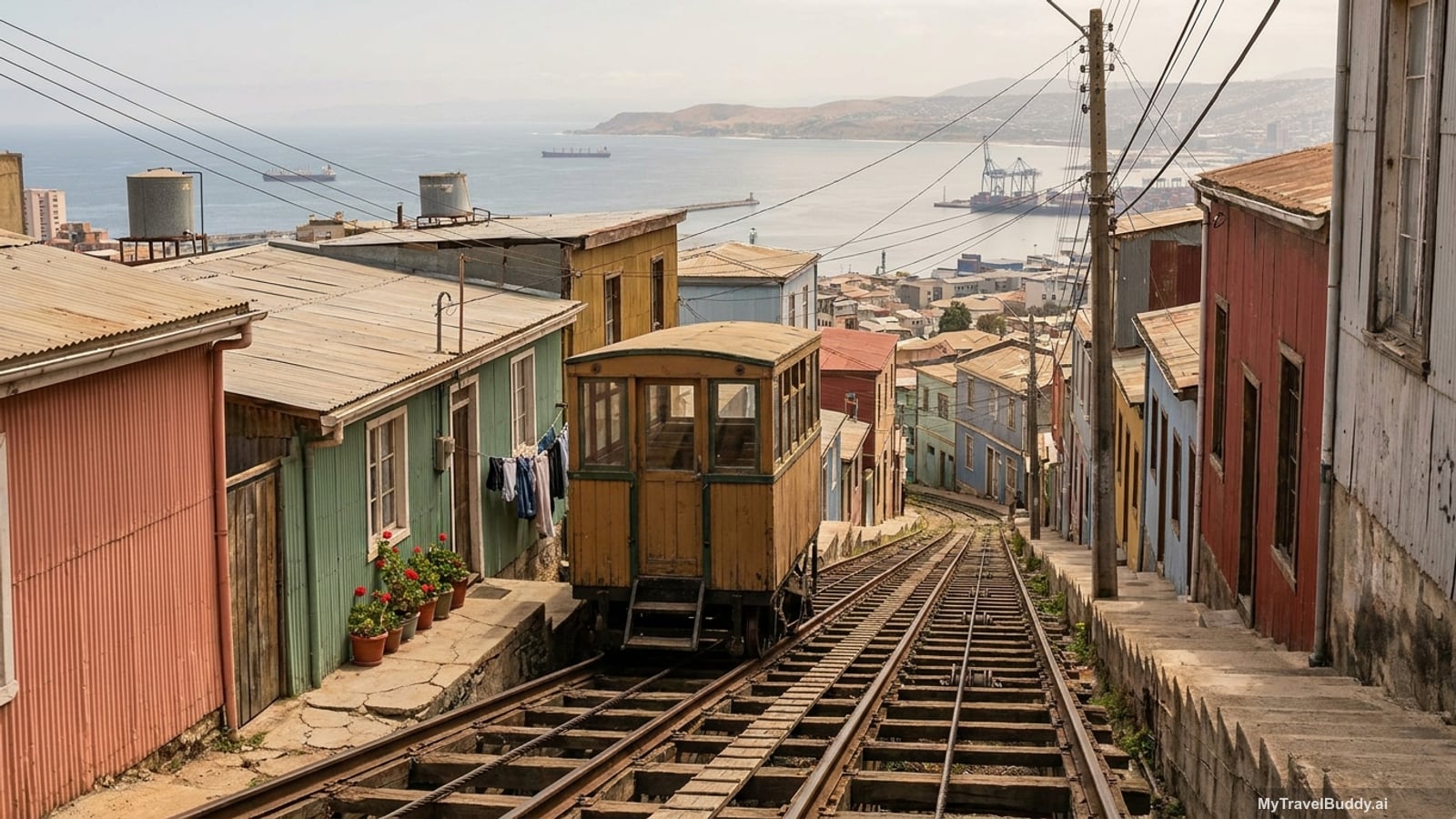
October 4, 2026 · Maya Roam
Valparaíso's Most Famous Elevator Is Closed. Seven Others Still Run.
Valparaíso built around thirty hillside funiculars from 1883 onward. Sixteen survive, seven carry passengers in 2026, and the one in every photograph — Artillería, climbing to the Paseo 21 de Mayo lookout — has been sto…
Read nextInspired to go?