
Travel story 9 min read
MyTravelBuddy Stories
In Daisetsuzan, the Color Is Already Below the Summit
Japan's autumn season opens on a volcanic massif in central Hokkaido, and in 2026 it already peaked — the Asahidake ropeway's 1,600-metre station is reporting snow and −2°C while Asahikawa sits near 20°C. Here is where…
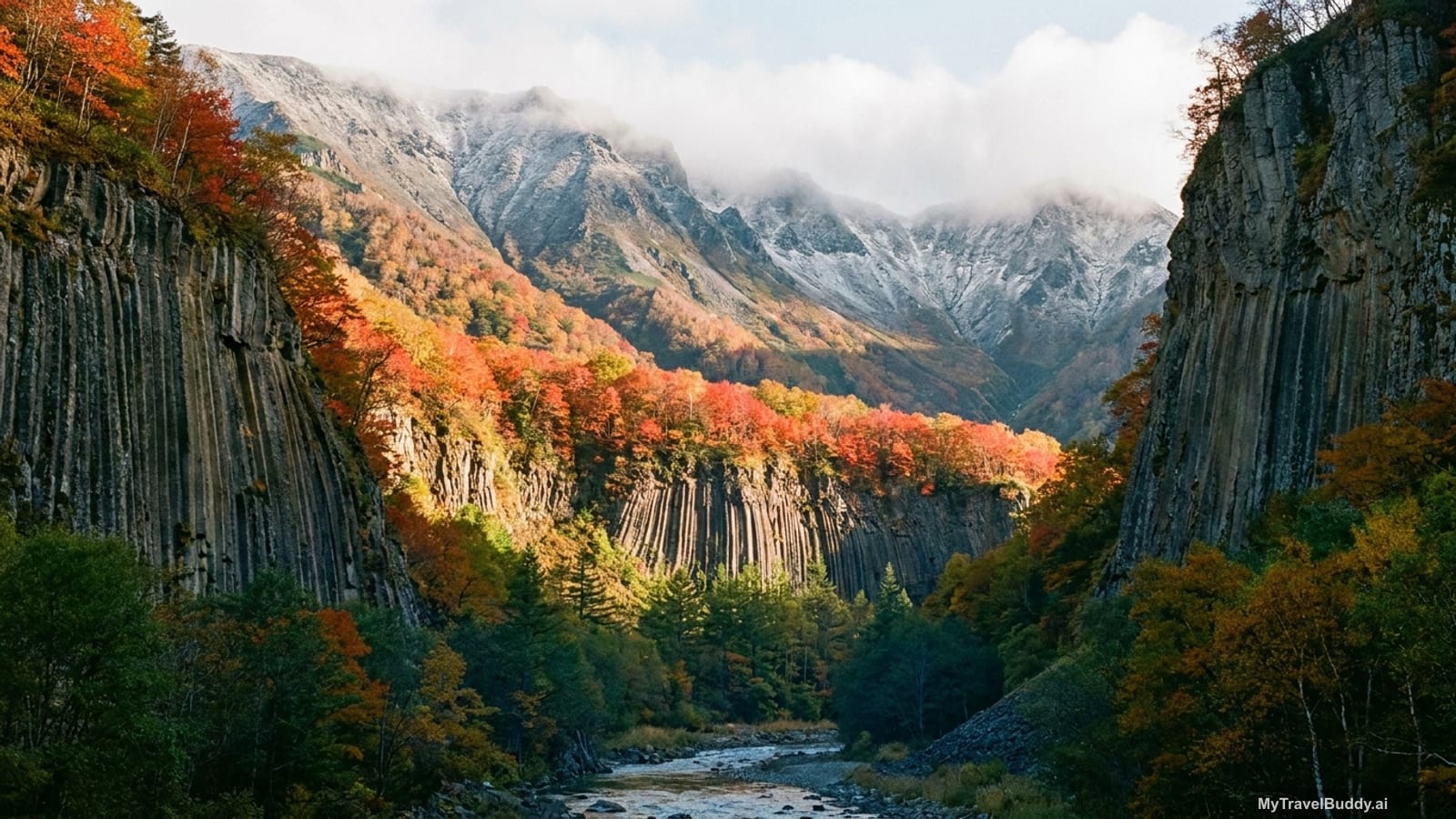
Right now, as I write this, two places about seventy kilometres apart in central Hokkaido are having completely different Octobers. In Asahikawa, down on the plain at 117 metres, the forecast for the next few days tops out around 18 to 21°C — jacket-over-a-t-shirt weather, the kind of light, generous autumn that makes you linger over a bowl of ramen. Up at Sugatami, the Asahidake Ropeway's upper station at 1,600 metres, the operator's live conditions board reads: snow, −2°C, wind 14 metres per second, visibility poor.
Both of those are true on the same afternoon. That seventeen-degree gap is the single most useful thing to understand about Daisetsuzan in early October, and almost nobody tells you about it before you book.
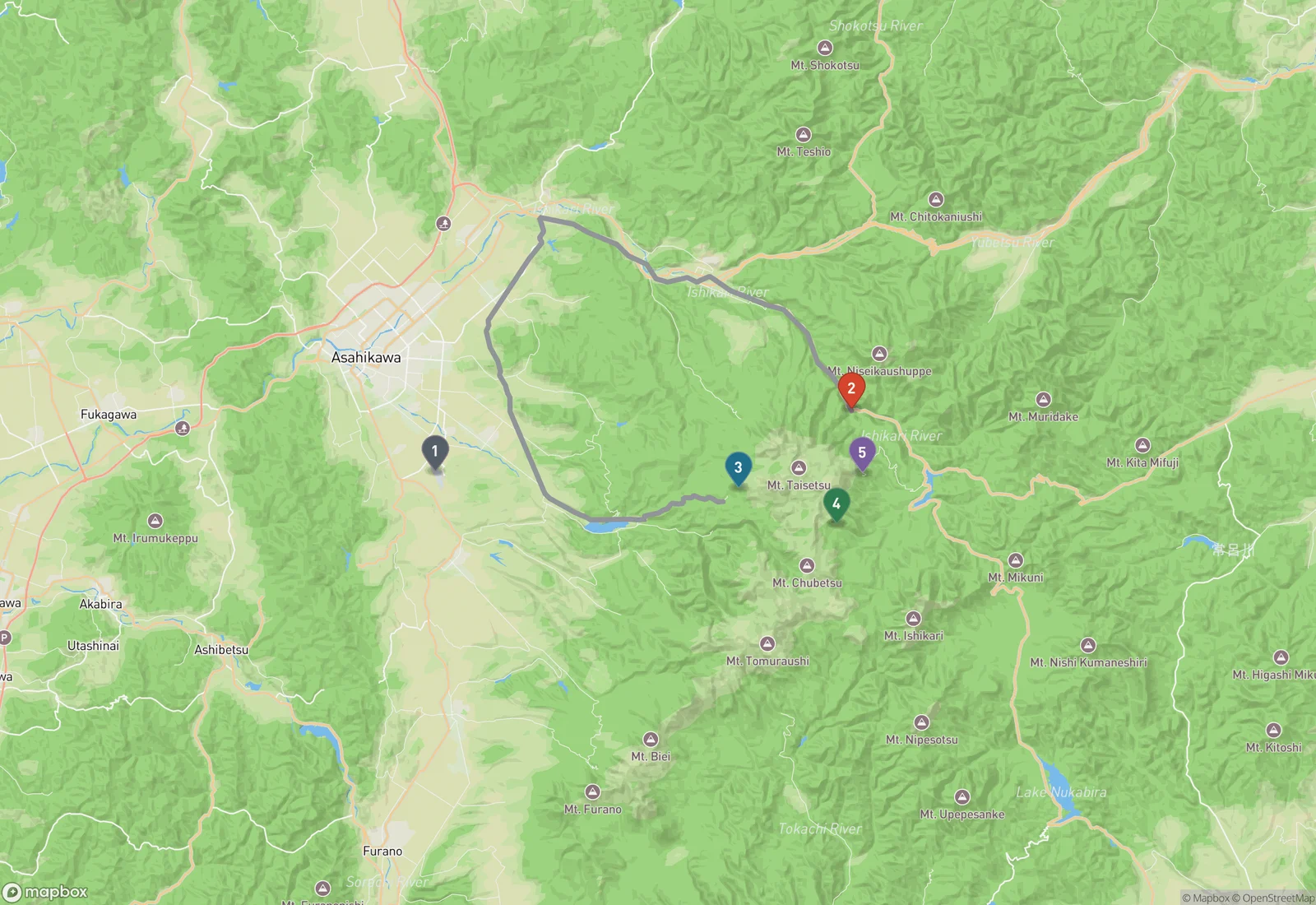
1 Asahikawa Airport. 2 Sounkyo Onsen and the Kurodake Ropeway. 3 Asahidake Ropeway. 4 Kogen Onsen. 5 Ginsendai. The grey line is the road between Sounkyo and Asahidake — 99 km and about an hour and three quarters, for two trailheads you could almost wave at each other from.
Japan's autumn starts here, and it starts at the top
Daisetsuzan is where the Japanese autumn begins. Not Kyoto in late November, not Nikko in October — here, on a volcanic massif in the middle of Hokkaido, in the back half of September. Mount Asahidake is Hokkaido's highest peak at 2,291 metres, and the alpine basin around the ropeway's upper station turns weeks before anywhere on Honshu.
This year it turned well. After several hot summers that dried the leaves out before they could colour, 2026 ran closer to average, and the ropeway's own blog called it the first genuinely vibrant autumn in five years. When japan-guide visited Sugatami on 17 September, the circular trail around the upper station was at full peak.
That was two weeks ago. The important part of the sentence is what comes next: the colour does not stay. It walks downhill.
It starts around the Kurodake summit in mid-September and slides down the slopes until it reaches the floor of Sounkyo Gorge around mid-October. Roughly a month, roughly 1,300 vertical metres, moving at a pace you can almost schedule around.
Which means that if you arrive in Daisetsuzan this week expecting the photographs you saw in late September, you will go up the mountain and find winter.
The top tier has already shut, or is about to
This is the part that catches people, because it isn't about the leaves at all. It's about gates and timetables.
Ginsendai — the single most photographed early-autumn slope in the park — ran its private-car restriction from 12 to 23 September this year, with the gate closed from 19:00 on the 11th. That window is over. More to the point, the unpaved road up to Ginsendai closes for the season in early October and does not reopen until late June. For a traveller arriving now, it is simply not on the table.
Kogen Onsen, the marsh circuit south of Sounkyo, had its own car restriction from 19 to 30 September. The Numa-meguri loop itself runs on a tighter leash: the 2026 season is 10 June to 5 October. Access is managed by the Daisetsu Kogen Onsen Higuma Information Center — this is serious brown bear country, with patrollers on the course and a compulsory briefing before you set foot on it. Check-in for the briefing runs 07:00 to 13:00 and the course is walkable 07:00 to 15:00. There is no phone at the centre, and the loop can be closed outright at short notice if a bear moves in, so treat any plan here as provisional.
If you want the marsh loop, you have until the fifth. After that the gate on that road closes too.
The Kurodake Ropeway at Sounkyo is still running, but it is already winding down for the year. From 1 October its hours shortened to 07:00–17:00, and from 16 October they contract again to 08:00–16:00 — the same day the chairlift above the fifth station stops for the season. The ropeway then closes entirely for maintenance from 9 to 30 November.
The Asahidake Ropeway is running 08:00 first car up, 17:00 last car down. Peak-season fares (1 June to 31 October) are ¥3,500 round trip for junior-high age and up, ¥2,200 one way, ¥1,750 and ¥1,100 for elementary students.
Look at that last-car time next to the sunset. Sounkyo sets at 17:04 on 4 October and 16:51 by the 12th — losing roughly two minutes a day. The mountain effectively closes at dusk, and dusk is arriving faster than you think.
So where is the colour this week?
In the middle. That is the honest answer, and it's a better answer than it sounds.
The band has dropped off the alpine zone and is working through the mid-mountain birch and rowan — the stretch between roughly 700 and 1,500 metres. At Sounkyo that puts it right where the Kurodake Ropeway deposits you at the fifth station, and on the forested walls above the gorge. The valley floor at Sounkyo Onsen sits at about 670 metres and won't hit its own peak until around mid-October, so the village itself is still in the green-to-gold transition.
There's a real pleasure in this stage that the peak-week crowds never see. You get colour in layers instead of colour all at once: snow and bare rock on the ridgelines, fire through the middle, green down by the river. The illustration at the top of this piece is my attempt to draw that stratification rather than a photograph of it, but the three layers are the thing to look for when you arrive.
And the crowds have gone home. The Ginsendai buses stopped running ten days ago. The tour groups chased the alpine peak and left.
A two-day shape that works this week
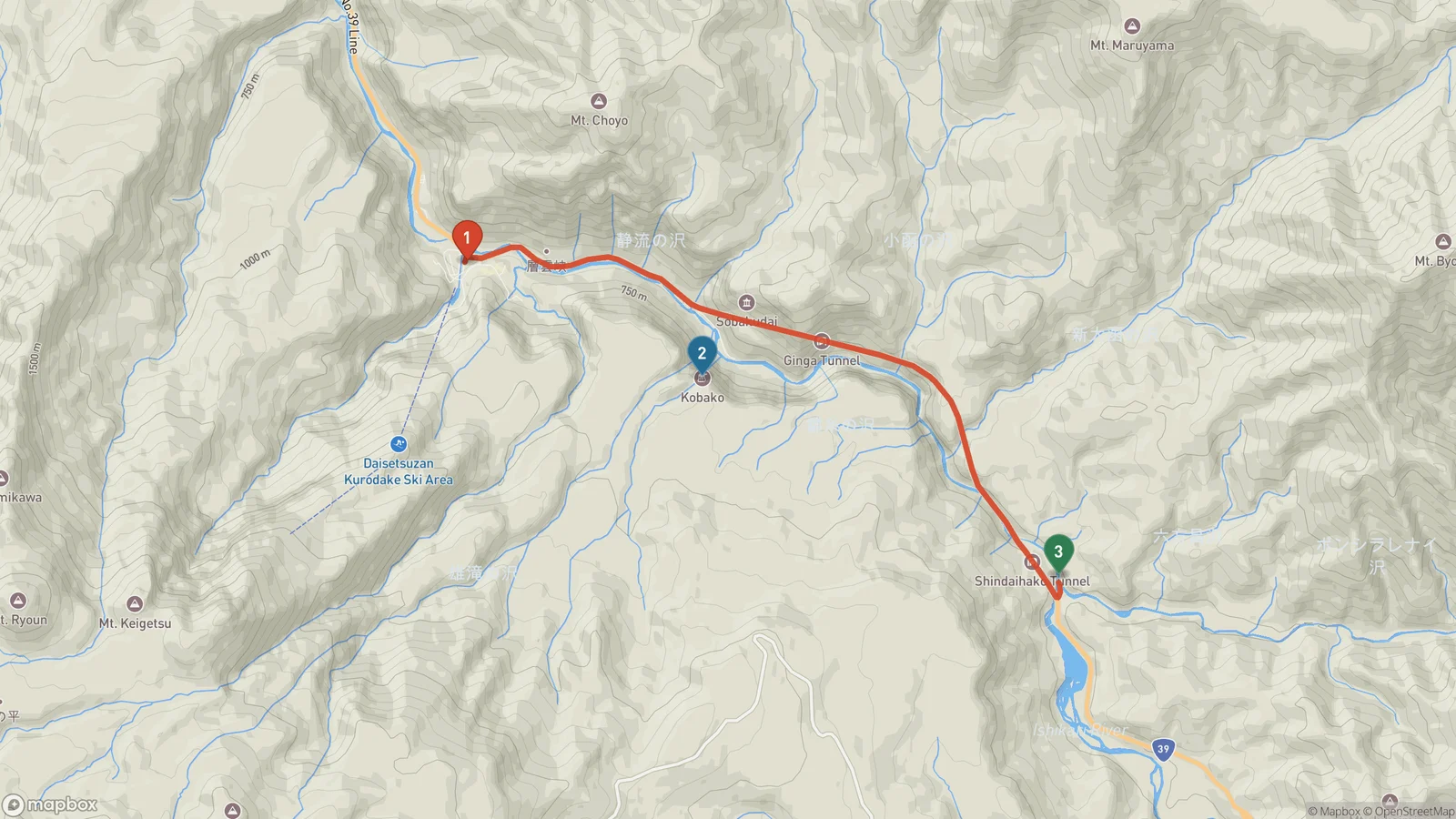
The gorge-floor day: 1 Sounkyo Onsen, 2 Ginga and Ryusei falls, 3 Obako. Ten minutes of driving end to end, and a full morning if you walk the viewpoint.
Base yourself in Sounkyo, not Asahidake. This is the week for it. The village has a cluster of onsen ryokan, a public bath house in the centre — Kurodake no Yu — and most ryokan open their baths to day visitors for around ¥1,000 if you're not staying. It's also the only one of the two trailheads with anything resembling a town.
Day one, go up. First ropeway at 07:00, chairlift above it, and then you're within about an hour's hike of the Kurodake summit at 1,984 metres. You do not have to go to the summit — the fifth and seventh station areas are where the colour is, and the walk between them is about thirty minutes. Be honest about conditions: this is a real mountain, the weather turns fast, and the ropeway operators post warnings about exactly that for a reason.
Day two, stay low. Drive or taxi three kilometres east to Ginga no Taki and Ryusei no Taki, two waterfalls dropping down a hundred-metre cliff face — four minutes from the village. The observation deck above them is a steep 15–20 minute climb from the car park and worth it. Another five kilometres up the valley is Obako, a folded rock formation in the river; ten minutes total from Sounkyo. The old cycling path that used to link them is permanently closed, and public transport along the valley is genuinely poor, so this is a car-or-taxi morning.
On the forecast, the window looks like this: 3 October is wet, with snow likely above 1,300 metres. The 4th and 5th are cold and dry — the Sounkyo grid point, which sits a little above the village itself, runs about −0.2 to 9.6°C and then 1.5 to 14.3°C, with clear skies. The 6th turns wet and unusually warm. Then the 7th through the 10th settle into the kind of crisp, dry, low-single-digit mornings that make the colour read properly. If you have flexibility, that second window is the one.
The ninety-nine kilometre mistake
Look at the map again. Sounkyo and Asahidake Onsen sit on opposite flanks of the same mountain, about seventeen kilometres apart as a crow would fly it. People see that and plan to do both in a day.
There is no road across. The drive is 99 kilometres and about an hour and forty-five minutes, swinging all the way west around the massif and back down through the Asahikawa plain. Only hikers cross the interior, and that is a one-to-two-day traverse for experienced walkers.
Pick one side, or give each side its own night. Asahidake Onsen is the better base if you're flying in and out of Asahikawa Airport — 38 km, about 45 minutes. Sounkyo is 72 km and about 76 minutes from the same airport, or 22 km and 24 minutes from JR Kamikawa Station.
Without a car: direct buses run Asahikawa Station to Sounkyo in about two hours for ¥2,140 one way, every one to three hours. Or take the JR train to Kamikawa (70 minutes, ¥1,380) and the bus from there (30 minutes, ¥890, every one to two hours). Some Sounkyo ryokan run free shuttles for staying guests from Asahikawa or even Sapporo — worth asking when you book.
Pack for both mountains
Go back to that seventeen-degree spread. You will have breakfast in Asahikawa in a light jacket and be standing in snow ninety minutes later.
Bring a proper insulating layer, a windproof shell, gloves, and a hat for the ropeway stations, and bring them even if the valley looks mild when you set out. Fourteen metres per second of wind at −2°C is not a day for a hoodie. Waterproof shoes with grip — the mid-mountain trails will be wet, and above about 1,300 metres there is already new snow on the ground. Then pack something much lighter for the gorge floor and for Asahikawa, because down there it's still properly autumn.
This is the sort of trip where a travel buddy that actually tracks elevation, closing dates, and the forecast for two altitudes at once earns its place — the mountain here is not one weather system, and the gates close on their own schedule rather than yours.
Daisetsuzan in the first week of October isn't the postcard. The postcard was two weeks ago and you missed it, and so did almost everyone. What's here instead is a mountain in the middle of handing its season downward, with empty trails, three distinct climates stacked on top of each other, and about ten days before the colour reaches the valley floor and the whole thing starts over at the bottom.
Go now, go low, and let the top of the mountain get on with becoming winter.
Continue wandering
One more story for the road
October 1, 2026 · Maya Roam
Your First Night Near Cusco Belongs in Urubamba
Flying into Cusco and sleeping there is the most common way to lose the first two days of a Peru trip. Go down to the Sacred Valley instead — about 460 metres lower — and climb by day. Here is the arrival drive, the Mar…
Read nextInspired to go?