
Travel story 6 min read
MyTravelBuddy Stories
Give Kakheti a Night, Not a Day Trip
Georgia's grape harvest is running right now in the Alazani Valley, and the usual Tbilisi day trip spends both of its best hours on the road. Telavi is 90 km out and puts Tsinandali, Alaverdi and Napareuli inside a 25-m…
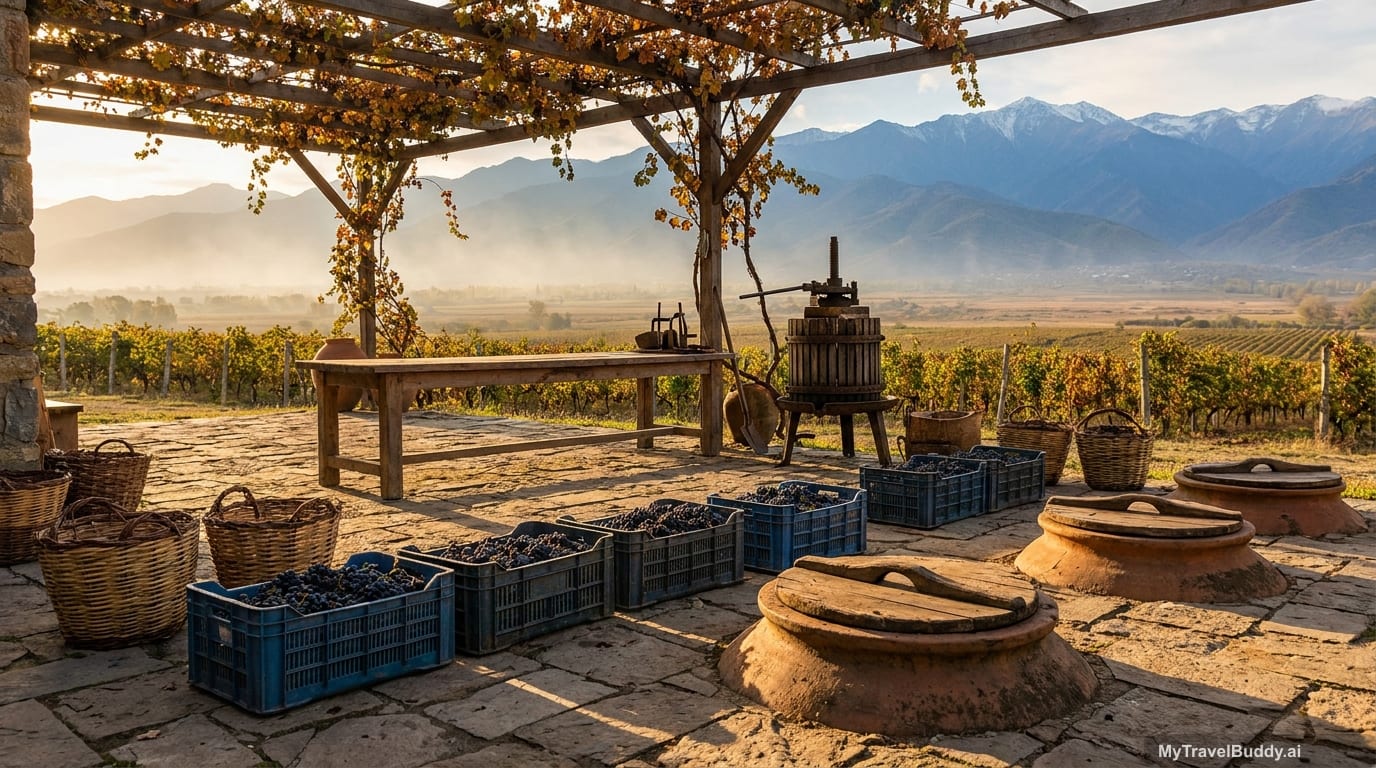
The crates give it away before anything else does. Late September in the Alazani Valley, and every winery courtyard in Kakheti has the same thing stacked in it — blue plastic crates, heaped with Saperavi so dark it reads black in shade, sitting on stone that is still warm at six in the evening. Somewhere behind them a hose is running. Somebody is shouting a number. This is rtveli, the Georgian grape harvest, and it is happening right now in eastern Georgia, about ninety minutes from Tbilisi.
Here is the thing almost every itinerary gets wrong about it: it treats Kakheti as a day trip. Leave Tbilisi after breakfast, photograph a hilltop town, taste something amber, be back for dinner. That works beautifully in June. During harvest it quietly wastes the only two hours that matter.
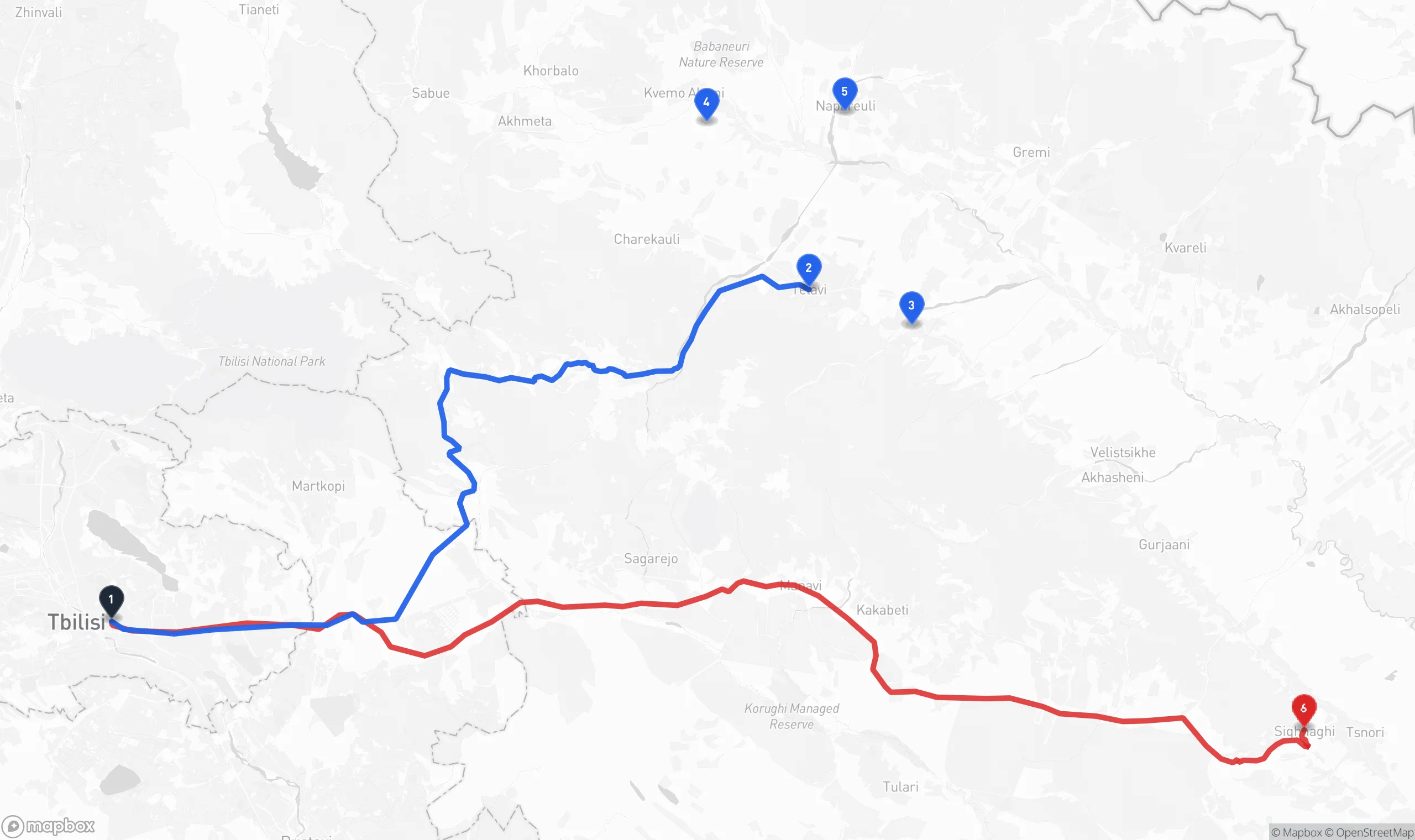
1 Tbilisi, 2 Telavi, 3 Tsinandali, 4 Alaverdi, 5 Napareuli, 6 Sighnaghi. Blue is the road over the Gombori Pass. Red is the usual day trip.
The two roads, and what they actually cost you
Both drives are longer than people expect, and they go to different places in more than the geographic sense.
Tbilisi to Sighnaghi, the walled hilltop town on every Georgia postcard, is about 107 km and roughly 1 hour 40 minutes each way on current routing. Tbilisi to Telavi, the unglamorous administrative town in the middle of the valley, is about 90 km and roughly 1 hour 37 minutes over the Gombori Pass — a twistier, prettier, occasionally slower road that climbs through beech forest and then drops you out onto the valley floor with the whole Caucasus wall standing across the horizon.
Nearly identical on the clock. Completely different in what they put within reach the next morning.
From Telavi, Tsinandali Estate — the nineteenth-century Chavchavadze house and its gardens, still one of the most-loved single stops in the region — is 10.8 km, about 16 minutes. From Tsinandali, Schuchmann Wines Chateau at Kisiskhevi is another 4.9 km, nine minutes. Alaverdi Monastery, whose eleventh-century cathedral rises straight out of a flat vineyard plain and whose monks still ferment in buried clay, is 20 km and about 25 minutes north. Napareuli, up at the top of the valley, is 23.6 km, around 26 minutes.
That is a whole region inside a twenty-five-minute radius. From Sighnaghi, the same cluster starts with a 62 km, 79-minute drive back across the valley — which is why the day-trippers don't do it.
Harvest is a workday, and you are a guest at it
Rtveli is not a festival with a schedule, even though a few estates now run ticketed versions of one. It is the single busiest fortnight of the working year, timed to sugar levels rather than to a calendar, which is why nobody can tell you in July exactly which week it will land in.
Practically, that means three things.
Wineries are at their most alive and their least available at the same time. The press is running, the qvevri are open, the courtyard smells like crushed fruit and wet stone — and the person who would normally walk you through it is elbow-deep in the day. Call or message ahead. A tasting booked two days out is a different experience from one you walk in on.
The good hours are early and late. Picking starts near first light, when it's cool and the fruit is firm; sunrise in Telavi is around 06:50 right now. The long tables come out after work, which in late September means after a roughly 18:45 sunset that is sliding about two minutes earlier every day. A day trip from Tbilisi spends both of those windows on the Gombori Pass.
And if you are invited to a supra — the long, toasted, tamada-led table that often closes a harvest day — accept slowly and clear your evening. It is not a two-hour dinner. It is also not something to photograph your way through.
Which week, if you can still choose
Open-Meteo's current outlook for Telavi is unusually clear about where the season turns. The next few days hold: highs near 21–22 °C through the 28th, with rain probability at 20% on the 26th, 1% on the 27th, and 45% on the 28th. Then the 29th looks like a genuine washout — 95% probability, about 4.4 mm — and after it the valley steps down and stays down. Highs in the 16–18 °C range through the first week of October, more days with rain than without, and overnight lows falling from the mid-teens to around 7–8 °C by the 4th and 5th.
Forecasts this far out move, so treat that as shape rather than certainty. But the shape is the useful part: the warm, dry, open-courtyard version of rtveli is closing this week, and the cool, sweater-and-indoor-marani version is what follows. Both are good. They are not the same trip, and they want different clothes.
If the day trip is genuinely all you have
Then take it, and take it to Sighnaghi — that's what Sighnaghi is very good at. It is compact, walkable, unreasonably photogenic above the valley, and it has Pheasant's Tears, one of the wineries most responsible for the qvevri revival reaching outside Georgia.
Give yourself the walk down to Bodbe Monastery, where St. Nino is buried: about 2.8 km from town, roughly 42 minutes on foot, mostly downhill on the way out along the cypress approach. Walk it out and take a taxi back rather than the reverse. Marshrutkas for Sighnaghi leave from the Samgori area on the eastern edge of Tbilisi, and the road from there is about 104 km, near 95 minutes when traffic behaves.
Just know what you are choosing: Sighnaghi is the view of the valley. Telavi is the inside of it.
Coming back down
Whatever shape your trip takes, leave the last morning in Tbilisi unscheduled. Go to Dezerter Bazaar and look at what the same season is doing to everything else — the walnut sacks, the churchkhela hung up in rows like candles, the sulguni in brine, the tarragon that Georgians treat as a fruit flavor. Then take the harvest out of your shoulders at the Abanotubani sulfur baths in the old town, where the domes sit half-buried in the hillside and the water arrives hot from underneath the city.
You will smell faintly of sulfur on the plane. Everyone does. It fades in about a day, which is roughly how long it takes to stop thinking about the valley.
Continue wandering
One more story for the road
September 26, 2026 · Maya Roam
On the Albanian Riviera, the Sea Is Still Warmer Than the Air
The Ionian is holding about 25.6°C while the air tops out near 23°C, the loungers are coming off the sand, and the coast road is finally empty. Himarë to Sarandë is only 55.7 km — and still takes ninety minutes, which i…
Read nextInspired to go?