
Travel story 9 min read
MyTravelBuddy Stories
Enter Petra by the Back Door, Leave Through the Siq
Almost everyone walks into Petra through the Siq at nine in the morning. Start at Little Petra instead, arrive at the Monastery from above, walk down through the city, and meet the Treasury at four — with the trail dist…
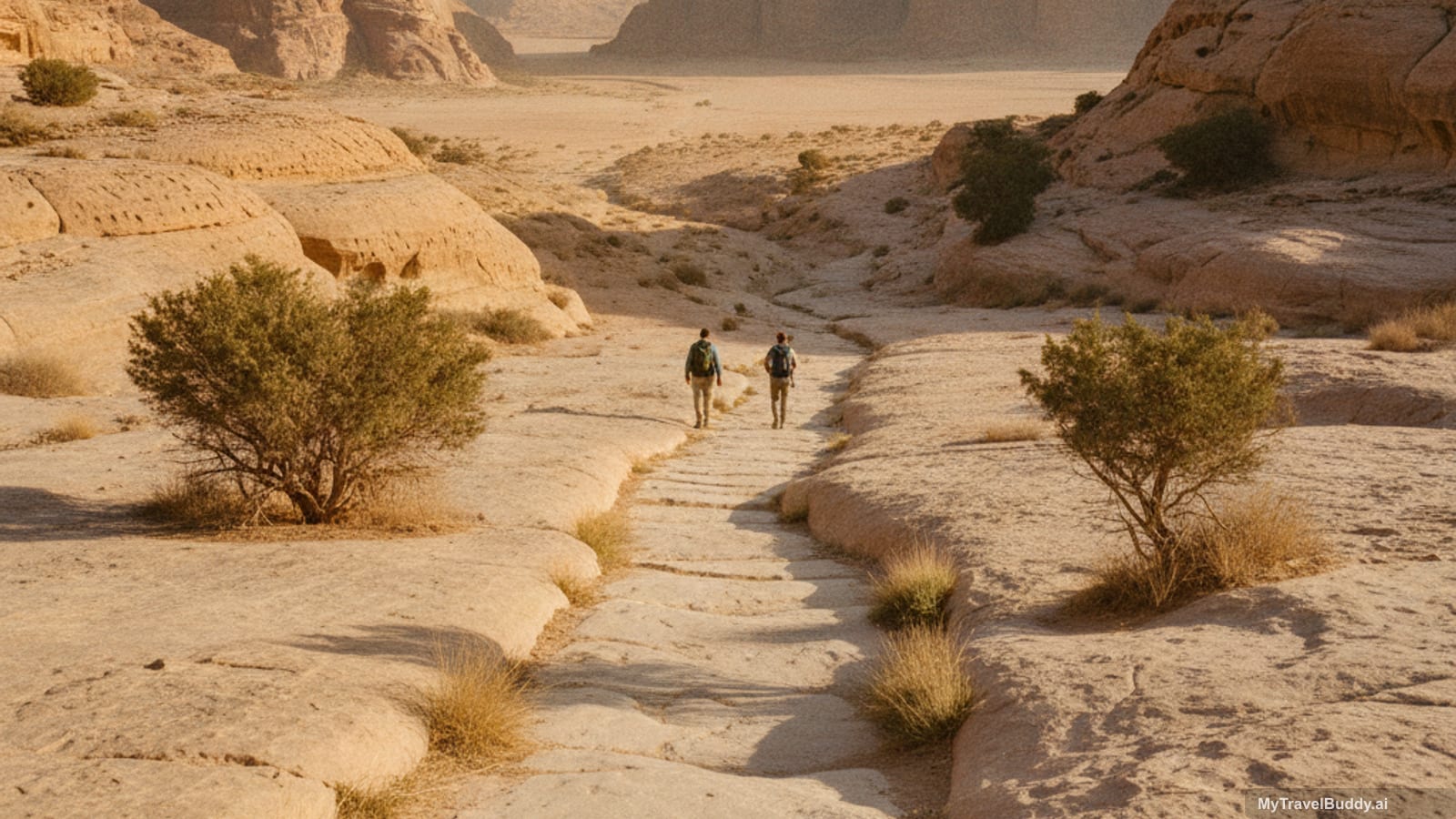
Almost everyone meets Petra the same way. You queue at the gate in Wadi Musa, walk down through the Siq shoulder to shoulder, and the Treasury arrives in the first hour of your day, framed by a hundred phones held over a hundred heads. It is still extraordinary. It is also, by then, completely expected.
There is another way in, and it changes the order of everything. You start eight kilometres north at Little Petra, walk over the sandstone the long way, and the first monument you see is the Monastery — Ad Deir — appearing in a cliff face with no crowd in front of it. Then you walk down into the city, through the parts most visitors are too tired to reach, and you come out at the Treasury in the late afternoon, when the light has gone gold and the tour buses have gone home. The Siq becomes your exit, not your entrance.
I love this route because it fixes the thing that quietly ruins Petra for a lot of people: doing the whole site as an out-and-back from one gate, and spending the last hour climbing back up something you already climbed down.
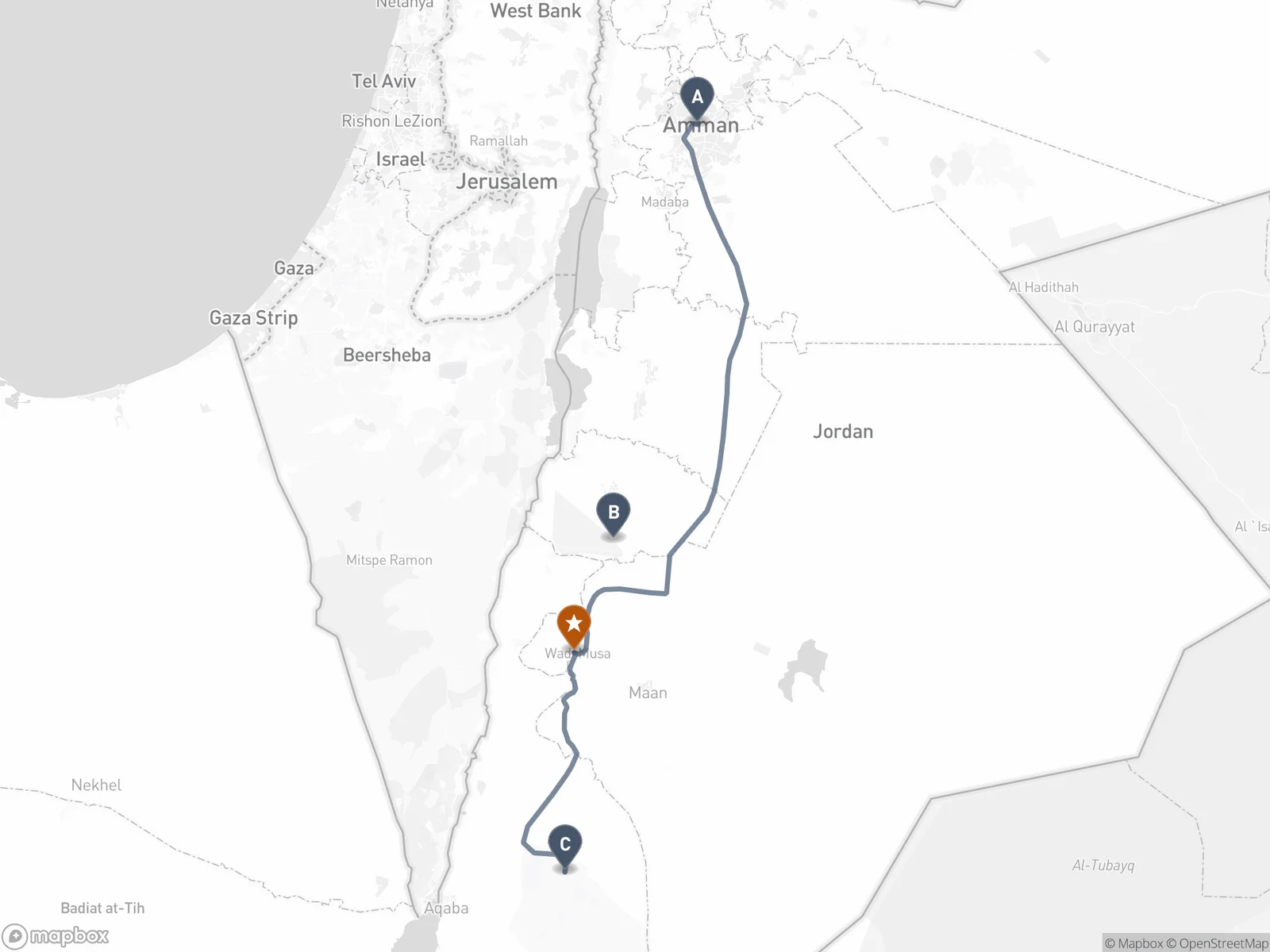
A: Amman. B: Dana Biosphere Reserve. C: Wadi Rum. The star is Wadi Musa, the town at Petra's main gate — about 238 km and a little over three hours' drive south of Amman.
The ticket problem, which is no longer a problem
The old catch with the back route was administrative. Petra tickets were sold at the main visitor centre in Wadi Musa, and the back trail drops you inside the site — so you either drove to the gate first to buy a pass and then doubled back north, or you relied on a guide to sort it out.
The Jordan Trail Association now notes that a ticket office at Little Petra sells the Petra pass directly, so you no longer have to start your day at the main gate to enter legally from the north. That is a genuinely useful change, and it makes the whole plan much less fiddly. Still confirm it with your guide or hotel the night before — this is recent, and small offices in Jordan keep their own hours.
On price: overnight visitors pay a lower rate than same-day visitors who do not sleep in the country, and multi-day passes cost only a little more than a single day. If you are flying in anyway, look at the Jordan Pass, which bundles the visa waiver with Petra entry. Rates change, so check the official Petra Development and Tourism Region Authority pass site before you budget.
The walk itself
Little Petra — Siq al-Barid, the "cold canyon" — is worth thirty minutes on its own before you start. It is a miniature of the main site: a slot canyon with carved triclinia and, in one biclinium ceiling, faded Hellenistic frescoes of vines and birds. It opens early, around 6am, which suits you perfectly.
From there the trail runs roughly south. The Jordan Trail's Section 604 measures the Little Petra to Petra stretch at about 12.6 km; route-planning the walking line gives something closer to 9.5 km and about two and a half hours to the Monastery, which matches what most people actually experience. Add stops, add the pull of the view, and call it three hours.
The terrain is mostly gentle by hiking standards. Good tracks go down Wadi Ghurab between sandstone mountains, following an old Nabataean route out of the valley. Near the end it skirts a mountain on a natural rock terrace, improved for safety, that narrows a little before opening onto a hidden plateau high above the chasm of Wadi Siyyagh. If you are uneasy with exposure, this is the section to know about in advance — it is short, it is not technical, and it is the only part of the day that asks anything of your nerve.
Two practical notes that are not optional. The Jordan Trail is not waymarked, and the association's own guidance is to hire a local guide — the terrain is remote, water sources are limited, and phone signal comes and goes. And you should be walking by 7am. In the first half of October you have roughly 11 hours and 50 minutes of daylight: sunrise around 6:32, sunset around 18:20.
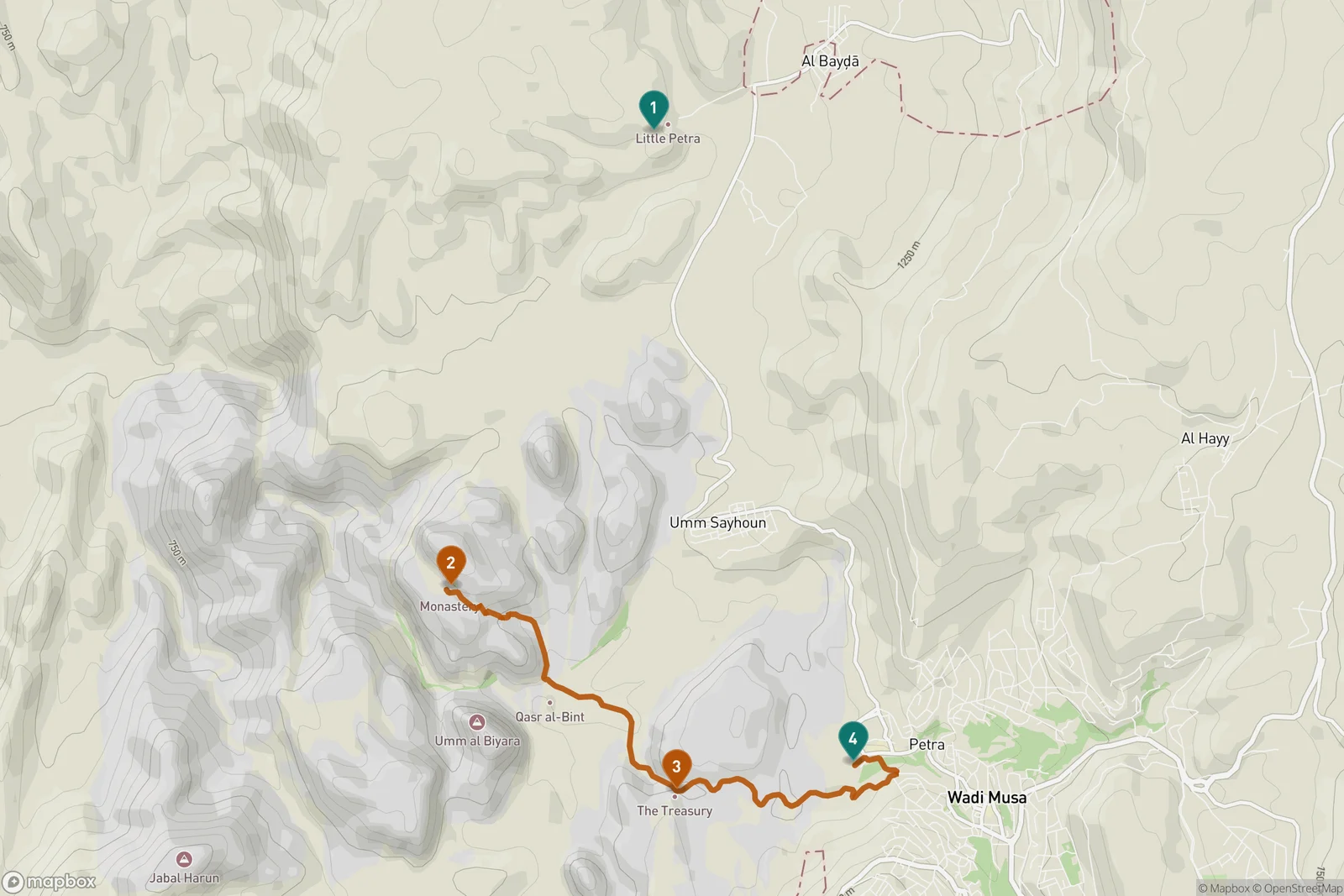
1 Little Petra, 2 the Monastery, 3 the Treasury, 4 the visitor centre. The orange line is the second half of the day — about 3.4 km from the Monastery down to the Treasury, then another 3.1 km out through the Siq.
Arriving from above
The Monastery does not build up. You come round the terrace, the plateau opens, and it is simply there in the cliff — fifty metres of carved façade, bigger than the Treasury and far less photographed. There is a Bedouin café opposite, which is the correct place to sit for twenty minutes with a mint tea and let the scale land.
The people who arrive here the other way have just climbed something like 800 rock-cut steps up from the valley floor. You arrived on the flat. That asymmetry is the whole argument for this route.
Down through the middle of Petra
Nabataean steps lead down from the Monastery into the city, and this is the part of the day I would protect most fiercely. Most visitors experience Petra as a corridor — Siq, Treasury, maybe the Street of Facades, turn around. Coming down from the north you land in the middle of it: the Great Temple, the colonnaded street, Qasr al-Bint at the foot of the valley.
Time your lunch here. The Basin Restaurant, the sit-down option in the valley near Qasr al-Bint, keeps roughly 9am to 4pm hours, so a 1pm arrival is comfortable and a 4:30pm arrival is not. If you would rather not commit to a buffet, carry bread, cheese and fruit from Wadi Musa and buy tea from the stalls along the way.
From the valley floor it is about 3.4 km and an hour of easy walking to the Treasury. You will pass the theatre and the Royal Tombs cut into the eastern cliff on your right. If your legs still have anything in them, the Al-Khubtha trail climbs from near the Royal Tombs to the viewpoint that looks straight down onto the Treasury from above — it is a real climb, and it is the single best photograph in Petra.
The Siq, in the right direction
Then the Treasury, some time after 4pm, with the crowd thinned to a fraction of what it was at nine. And then the Siq — 1.2 km of narrow sandstone corridor — walking outward, slightly uphill, in the last of the light.
Walking the Siq out rather than in is genuinely different. In the morning you are pushing toward a reveal. In the evening you are leaving, the walls are warm, the groups have gone, and the carved water channels and votive niches that nobody looks at on the way in are suddenly the thing you are looking at. It is about 3.1 km and 50 minutes from the Treasury to the visitor centre. The main gate closes around 5pm for entry in this season, so plan to be walking out, not asking questions at the desk.
Total for the day: roughly 16 km, nearly all of it downhill or flat, with one monument at the start, one at the end, and an entire ancient city in between.
Why early October is the window
The numbers are kind right now. The forecast for Wadi Musa over the first half of October runs highs of about 20–27 °C with overnight lows of 15–19 °C, and essentially no rain in the near-term outlook — one modest 0.6 mm signal around 6 October is the only wet blip. That is close to ideal walking weather in a place that is brutal in July.
Two caveats. October is the front edge of Jordan's rain season, and Petra's wadis flash flood: if there is heavy rain anywhere upstream, authorities close the Siq and the side canyons, and you follow that instruction without negotiating. Forecasts are forecasts — check the morning of, and ask your guide.
Second, altitude matters more than latitude here. Wadi Musa sits high enough that evenings are properly cool — bring a fleece for dinner. Wadi Rum, only 105 km and under two hours south, is forecast 5–7 °C warmer by day in the same stretch. If you are combining the two, pack for both.
Where this fits in a Jordan week
The sensible shape is two nights minimum in Wadi Musa. Day one: the back route, as above. Day two: a short second entry through the Siq in the morning, when you already know the site and can go looking for specific things — the Royal Tombs at first light, the High Place of Sacrifice, the Petra Museum near the gate, which stays open to 7:30pm and is the best pre-dinner hour in town.
If you can add a night before Petra rather than after, spend it at Dana. The biosphere reserve sits about an hour north on the way down from Amman, the reception area keeps daytime hours, and the village at the lip of the valley is the quietest place in southern Jordan at sunset. Shobak Castle, a Crusader ruin open roughly 9am to 5pm, makes a good thirty-minute stop on the same drive.
For dinner in Wadi Musa: Beit Al-Barakah keeps long hours from early morning to midnight, and My Mom's Recipe runs roughly 10am to 11pm — both a short walk from the cluster of hotels above the gate. After a 16 km day you will want food that arrives quickly and a room that is close.
Getting there: about 238 km and just over three hours' drive from Amman, or the single daily JETT bus that leaves Amman around 6:30am and returns in the late afternoon. A rental car is worth it if you are stringing together Dana, Petra and Wadi Rum; if Petra is your only stop, the bus is fine and the hotels are walkable.
One last thing. If Petra by Night falls on a night you are there — it typically runs Monday, Wednesday and Thursday evenings, on a separate ticket — do it on your second night, not your first. You want to see the Siq in daylight before you see it by candle.
Continue wandering
One more story for the road
September 29, 2026 · Maya Roam
Pack for Two Climates: Uzbekistan in the First Week of October
Bukhara is forecast at 35°C next Saturday and 19°C two days later. That break is why early October is the best week to ride the Afrosiyob from Tashkent to Samarkand to Bukhara — with the opening times, station distances…
Read nextInspired to go?